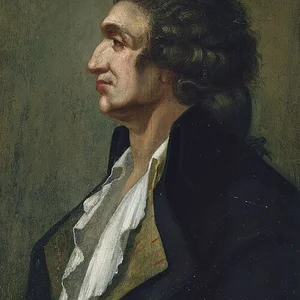

Mathematician and Enlightenment philosopher (1743–1794), Condorcet served as Permanent Secretary of the Academy of Sciences, championed equal rights for women and enslaved people, and played an active role in the French Revolution. He died during the Reign of Terror, having written his intellectual testament on human progress.
Marie Jean Antoine Nicolas de Condorcet
Marie Jean Antoine Nicolas de Caritat, Marquis de Condorcet
9 min read
Frequently asked questions
Famous Quotes
« Nature has linked truth, happiness, and virtue by an indissoluble chain.»
« The sole foundation of belief in the natural sciences is the idea that the general laws, known or unknown, which govern the phenomena of the universe, are necessary and constant.»
Key Facts
- 1743: born in Ribemont (Aisne)
- 1769: elected to the Academy of Sciences for his work in integral calculus
- 1785: publishes the *Essay on the Application of Analysis to the Probability of Decisions* (Condorcet paradox)
- 1790: writes *On the Admission of Women to the Rights of Citizenship*, a plea for women's suffrage
- 1793–1794: writes *Sketch for a Historical Picture of the Progress of the Human Mind*; dies in detention during the Reign of Terror
Works & Achievements
A founding work of the mathematical theory of voting, in which Condorcet demonstrates his famous "paradox" of cycles in collective preference. This text remains central to contemporary research in social choice theory.
An abolitionist pamphlet published under a pseudonym, in which Condorcet condemns slavery as a crime against humanity and calls for its gradual abolition. One of the earliest anti-slavery texts by a major European intellectual.
A pioneering text of political feminism, in which Condorcet argues that women possess the same natural rights as men and must be granted the right to vote. France would not achieve this until 1944.
A national education plan presented to the Legislative Assembly, advocating for free, secular public schooling open to both sexes. This text profoundly shaped the French republican school system of the nineteenth century.
An intellectual biography of Voltaire written by Condorcet, tracing the philosopher's lifelong struggle against fanaticism and intolerance. It illustrates the direct intellectual lineage between Condorcet and the previous generation of Enlightenment thinkers.
Condorcet's philosophical testament, written clandestinely during the Terror and published after his death. This text charts the history of humanity across ten epochs, culminating in an optimistic vision of the indefinite progress of reason and justice.
Anecdotes
Condorcet was one of the very few Enlightenment philosophers to publicly demand voting rights for women. In 1790, he published “On the Admission of Women to the Rights of Citizenship,” arguing that denying women this right amounted to violating the very principles of reason and equality. This text was revolutionary for its time — even among the revolutionaries themselves.
A brilliant mathematician, Condorcet discovered what is now known as the “Condorcet paradox”: in a multi-candidate vote, it is possible for the majority to prefer A over B, B over C, and yet C over A, creating a logical cycle with no clear winner. This discovery, now 240 years old, is still taught in mathematics and political science courses around the world.
Hunted by revolutionaries who had outlawed him in 1793, Condorcet hid for eight months in the home of a courageous widow, Mme Vernet, on the Rue Servandoni in Paris. It was during this confinement that he wrote his most celebrated work, the “Sketch for a Historical Picture of the Progress of the Human Mind” — a hymn to human perfectibility composed at the very moment his life was in danger.
In March 1794, fearing he was putting Mme Vernet at risk, Condorcet fled Paris in disguise. He was arrested at Clamart after his well-kept hands and knowledge of Latin betrayed his identity to the local villagers. A few days later, he was found dead in his cell at Bourg-la-Reine: whether by voluntary poisoning, exhaustion, or accident, the mystery remains unsolved.
Sophie de Grouchy, whom he married in 1786, was herself a remarkable philosopher: she translated Adam Smith into French and wrote her own “Letters on Sympathy.” Their Parisian salon was one of the most brilliant of the Revolutionary era, frequented by Thomas Jefferson, Paine, and the leading figures of the Atlantic Enlightenment.
Primary Sources
Either no individual of the human race has genuine rights, or all have the same; and whoever votes against the right of another, whatever that person's religion, color, or sex, has thereby renounced their own.
Our hopes for the future condition of the human race may be reduced to three important points: the destruction of inequality between nations, the progress of equality within each people, and finally the true perfection of humanity.
To reduce a man to slavery, to keep him in slavery, is a crime against humanity; and it is this crime that, in the European colonies, thousands of men commit with impunity and under the protection of law.
An attempt was made to subject to mathematical analysis truths that had seemed to belong solely to politics and morality; and it was found that reason and experience were in agreement with the results of that analysis.
Education must be universal — that is, extended to all citizens. It must be distributed with sufficient equality that no one is deprived of it; it must be free of charge.
Key Places
A small town in Picardy where Condorcet was born on September 17, 1743. His noble family quickly sent him to study in Reims and then Paris, far from this provincial backwater.
Condorcet's intellectual home and the site of his greatest recognition: he was appointed permanent secretary in 1776. It was here that he published his *Éloges des académiciens* and his major mathematical works.
The Paris residence of Condorcet and Sophie de Grouchy from 1786 onward, provided as an official dwelling tied to his post as Inspector General of the Mint. Their salon there brought together the leading figures of the Enlightenment and the Revolution.
It was here, in the home of the courageous widow Mme Vernet, that Condorcet hid for eight months in 1793–1794 to escape the Terror. During this time he wrote the *Sketch for a Historical Picture of the Progress of the Human Mind*.
The place where Condorcet died on March 28 or 29, 1794, in a cell at the inn serving as a prison, a few days after his arrest at Clamart. The exact circumstances of his death remain a historical mystery.
Condorcet was symbolically enshrined in the Panthéon in 1989 on the occasion of the bicentenary of the French Revolution, in tribute to his role in the Enlightenment and his defense of human rights. His coffin, however, could not be found.
Typical Objects

Condorcet's everyday instrument, with which he wrote thousands of pages of mathematics, philosophy, and political pamphlets. It was with this quill that he wrote his intellectual testament, the *Esquisse*, while hiding on the rue Servandoni.

Essential tools for any eighteenth-century mathematician, used by Condorcet in his calculations on probability and voting theory. Before calculators existed, these bulky volumes made it possible to carry out complex multiplications and divisions.

Emblematic instruments of the Enlightenment and the Académie des sciences, symbols of reason triumphant over obscurantism. Condorcet, trained as a geometer, used them for his mathematical demonstrations.

The collective masterwork of the Enlightenment to which Condorcet contributed, and which embodied the ideal of spreading knowledge that he championed. A symbol of the break with religious authority and of faith in reason.

The distinctive badge of the revolutionary citizen, which Condorcet proudly wore. Yet this symbol of republican commitment did not protect him from the Terror when he was declared an outlaw by the very people he had supported.

Condorcet maintained an extensive correspondence with European and American philosophers, including Thomas Jefferson, Adam Smith, and Voltaire. The letter was the social network of the Enlightenment, enabling the circulation of ideas across borders.
School Curriculum
Vocabulary & Tags
Key Vocabulary
Daily Life
Morning
Condorcet rose early and devoted the first hours of the day to his mathematical work, which required concentration and quiet. He worked at his desk in his apartment at the Hôtel des Monnaies, surrounded by calculation tables, manuscripts, and an extensive correspondence.
Afternoon
Afternoons were often given over to meetings at the Académie des sciences, visits from fellow philosophers, or the drafting of memoirs and official reports. During the Revolution, he spent many hours at the Legislative Assembly, taking part in debates and drafting legislation.
Evening
Evenings frequently gathered in the salon that Sophie de Grouchy hosted with great brilliance, bringing together philosophers, scientists, and politicians for discussions on equality, natural rights, and political economy. Jefferson, Paine, and Cabanis were among the visitors, in an atmosphere that blended intellectual rigor with revolutionary commitment.
Food
Like most Parisian intellectuals of his social circle, Condorcet ate at regular hours, with simple bourgeois meals: soup, roasted meats, vegetables, and seasonal fruit. Salon dinners were more lavish and drawn out, occasions for debate as much as for gastronomy.
Clothing
Condorcet dressed as an eighteenth-century gentleman: a fine woolen coat, breeches, white stockings, and a powdered wig in his youth, then natural hair under the Revolution, which abandoned powder. During his time in hiding, he wore plain clothes to blend in with ordinary people.
Housing
After his marriage, Condorcet lived at the Hôtel des Monnaies, a vast neoclassical building on the banks of the Seine — a prestigious residence tied to his administrative post. During the Terror, he lived in a modest room at Madame Vernet's house, unable to go out, entirely dependent on his reason and his books.
Historical Timeline
Period Vocabulary
Liens externes & ressources
Références
Œuvres
Essai sur l'application de l'analyse à la probabilité des décisions rendues à la pluralité des voix
1785
Réflexions sur l'esclavage des nègres
1781
Sur l'admission des femmes au droit de cité
1790
Rapport sur l'organisation générale de l'instruction publique
1792
Vie de Voltaire
1787
Esquisse d'un tableau historique des progrès de l'esprit humain
1795 (posthume)