 flip
flipFruits of the Hot Land with Salt and Chile
Fruits of the Hot Land with Salt and Chile
Why this dish? In his Letters to the King, Cortés marvels at the market of Tlatelolco, where unknown fruits from Europe were sold. His men refreshed themselves with them in the heat — a Mesoamerican street snack, direct ancestor of Mexican 'fruta picada'.
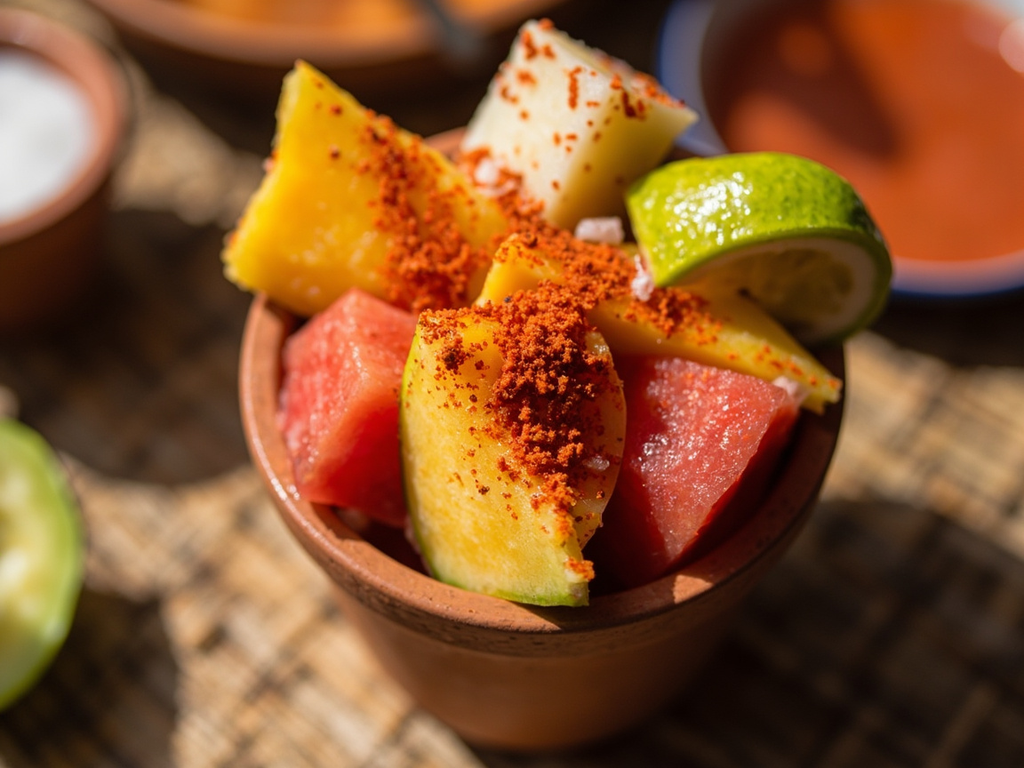
An assortment of cut tropical fruits, seasoned with salt and chile powder. Fresh, tart, sweet, and spicy all at once: the market snack as nibbled in the aisles of Tlatelolco.
If you had seen the great market of Tlatelolco, you would not believe your eyes: sixty thousand souls traded there every day, and I faithfully reported it to His Majesty in my letters. They sold fruits whose names we did not even know — the aguacate with its buttery taste, the vermilion mamey, the fragrant guayaba. In the heat, my men gladly refreshed themselves with them, cut with a knife and sprinkled with salt and ground chili. Such riches in these lands confirmed to me that God had led us to a new world.
- •Mamey — as desired (sweet, fleshy fruit)
- •Guava (guayaba) — a few (fragrant fruit)
- •Prickly pear (tuna) — as desired (sweet freshness)
- •Avocado (aguacate) — one (creamy richness)
- •Salt and chile powder — a pinch (to season the fruits)
Fruits of the Hot Land with Salt and Chile
An assortment of cut tropical fruits, seasoned with salt and chile powder. Fresh, tart, sweet, and spicy all at once: the market snack as nibbled in the aisles of Tlatelolco.
Why this dish? In his Letters to the King, Cortés marvels at the market of Tlatelolco, where unknown fruits from Europe were sold. His men refreshed themselves with them in the heat — a Mesoamerican street snack, direct ancestor of Mexican 'fruta picada'.
If you had seen the great market of Tlatelolco, you would not believe your eyes: sixty thousand souls traded there every day, and I faithfully reported it to His Majesty in my letters. They sold fruits whose names we did not even know — the aguacate with its buttery taste, the vermilion mamey, the fragrant guayaba. In the heat, my men gladly refreshed themselves with them, cut with a knife and sprinkled with salt and ground chili. Such riches in these lands confirmed to me that God had led us to a new world.
Ingredients (period version)
- Mamey — as desired (sweet, fleshy fruit)
- Guava (guayaba) — a few (fragrant fruit)
- Prickly pear (tuna) — as desired (sweet freshness)
- Avocado (aguacate) — one (creamy richness)
- Salt and chile powder — a pinch (to season the fruits)
Ingredients
- Mango, papaya, pineapple — an assortment (sweet fruits)
- Jicama and cucumber — 1 piece each (crunchy freshness)
- Guava or watermelon — according to season (juicy fruit)
- Chile powder (like Tajín) — 1 tsp (spiciness)
- Salt — 1 pinch (enhancer)
- Lime — 1 (modern touch) (acidity)
Method
- Peel and cut the fruits (and crunchy vegetables) into thick sticks or cubes.
- Arrange them in a cup or cone, like on a market stall.
- Sprinkle generously with salt and chile powder.
- Squeeze a little lime over the top (modern touch — citrus arrived only with the Spanish) and enjoy immediately, well chilled.
How it was made : The market of Tlatelolco, described by Cortés and Bernal Díaz, offered a profusion of fruits: mamey, guava, avocado, prickly pear, capulin. The habit of seasoning fruit with salt and chile is ancient in Mesoamerica. No sugar cane or citrus: freshness came from the fruit itself, acidity sometimes from xoconostle (sour prickly pear).
The contemporary twist : Serve in a cup as Mexican 'fruta picada': fruit sticks, salt, chile-lime (Tajín), and for the adventurous, a drizzle of chamoy syrup.
Sources : Hernán Cortés, Cartas de relación (second letter) · Bernal Díaz del Castillo, Historia verdadera de la conquista de la Nueva España
Hernán Cortés · Charactorium