 flip
flipHuahua kererū — forest pigeons preserved in their own fat
Huahua kererū — forest pigeons preserved in their own fat
Why this dish? Fat forest birds, caught in fruit season, were cooked and then submerged in their own fat to keep for months. These reserves fed the great funeral hākari given in honor of the dead — those who go to Hine-nui-te-pō.
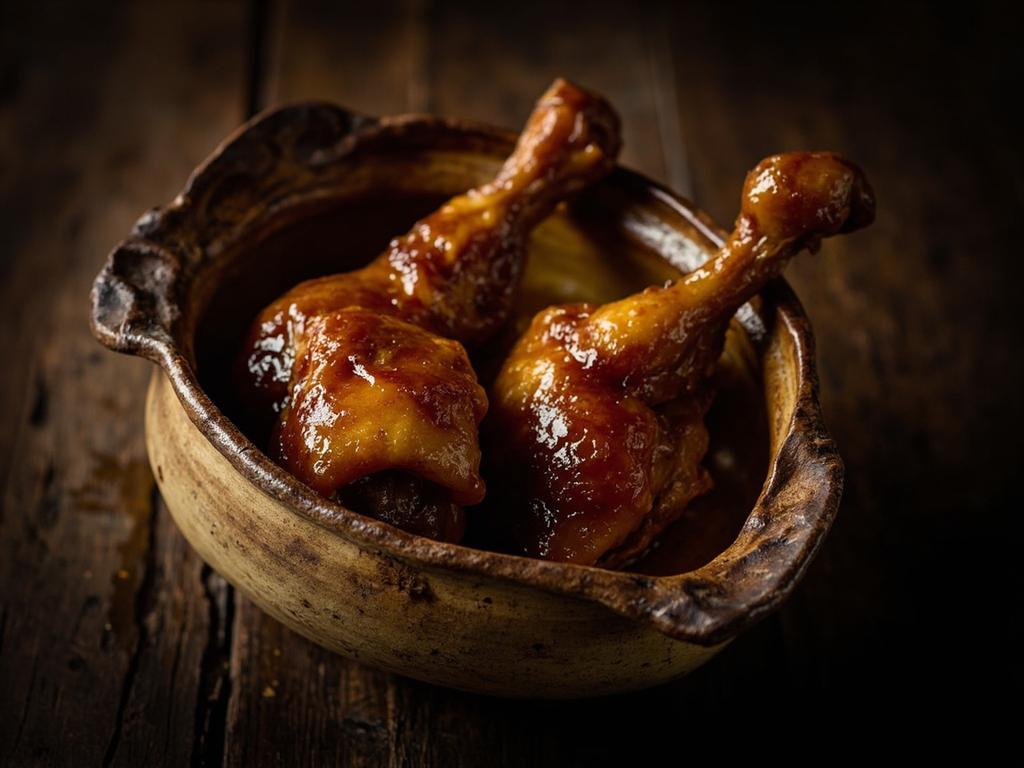
Fat birds gently cooked and then sealed under their solidified fat in a gourd: a dense, salty, deeply savory preserve, reopened for great occasions and mourning.
Listen to the wisdom of the seasons, child. When the miro and kahikatea bear fruit, the birds grow fat, and it is time to take them. We cook them in their own fat, lay them in the tahā, the gourd, and the fat sets over them like a cloak that keeps them from rotting. Thus the forest still feeds when winter bites and nothing flies. When the hākari comes to mourn a dead one, we open these reserves: we honor the one descending to me with abundance, not scarcity.
- •Kererū (fat forest pigeon) — as many as the hunt yields (meat to confit)
- •Rendered bird fat — enough to cover (sealant and preservative)
- •Tahā (gourd) or totara bark — 1 container (sealed reserve)
Huahua kererū — forest pigeons preserved in their own fat
Fat birds gently cooked and then sealed under their solidified fat in a gourd: a dense, salty, deeply savory preserve, reopened for great occasions and mourning.
Why this dish? Fat forest birds, caught in fruit season, were cooked and then submerged in their own fat to keep for months. These reserves fed the great funeral hākari given in honor of the dead — those who go to Hine-nui-te-pō.
Listen to the wisdom of the seasons, child. When the miro and kahikatea bear fruit, the birds grow fat, and it is time to take them. We cook them in their own fat, lay them in the tahā, the gourd, and the fat sets over them like a cloak that keeps them from rotting. Thus the forest still feeds when winter bites and nothing flies. When the hākari comes to mourn a dead one, we open these reserves: we honor the one descending to me with abundance, not scarcity.
Ingredients (period version)
- Kererū (fat forest pigeon) — as many as the hunt yields (meat to confit)
- Rendered bird fat — enough to cover (sealant and preservative)
- Tahā (gourd) or totara bark — 1 container (sealed reserve)
Ingredients
- Duck legs (ethical and legal substitute for pigeon) — 6 legs (fatty meat to confit)
- Duck fat — 500 g (slow cooking and sealant)
- Sea salt — 2 tbsp (salting and preservation)
- Sterilized glass jar — 1 (modern sealed reserve)
Method
- Rub the duck legs with salt, let rest 6 to 12 hours in the fridge, then wipe dry.
- Melt the duck fat over very low heat and submerge the legs completely.
- Cook for 2 to 3 hours at a barely perceptible simmer (around 90 °C), until the meat pulls away from the bone.
- Pack the legs into a sterilized jar, cover completely with strained fat, leaving no air bubbles.
- Let set and store in a cool place: the fat seals the meat, which keeps for several weeks. Reheat gently before serving.
How it was made : Huahua was a central preservation technique: kererū, tūī, or kākā were cooked and then stored under fat in gourds (tahā huahua) or bark containers, sometimes decorated. Today the kererū is strictly protected in New Zealand — hence duck as a respectful substitute. The method itself is the exact ancestor of confit.
The contemporary twist : Present a shredded confit leg on a warm kūmara flatbread, a little perfumed fat on top: huahua revisited as a festive bite.
Sources : Elsdon Best, Forest Lore of the Maori (1942) · Te Ara — The Encyclopedia of New Zealand, « Birds as food »
Hine-nui-te-pō · Charactorium