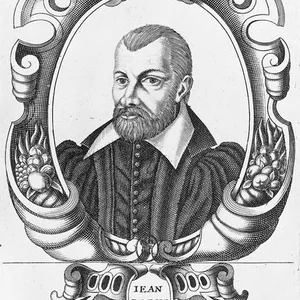

Jean Bodin was a French jurist, philosopher, and political theorist of the Renaissance. He is famous for developing the modern theory of state sovereignty in *The Six Books of the Commonwealth* (1576).
Jean Bodin(1530 — 1596)
Jean Bodin
France
6 min read
Frequently asked questions
Famous Quotes
« There is no wealth nor strength but in men.»
Key Facts
- Born around 1529 or 1530 in Angers
- Published *The Six Books of the Commonwealth* in 1576, founding the modern theory of sovereignty
- Member of the Third Estate at the Estates-General of Blois in 1576
- Author of *On the Demon-Mania of Witches* (1580), a treatise on witchcraft
- Died in 1596 in Laon, carried off by the plague
Works & Achievements
A treatise on historical method that proposes comparing peoples and political regimes in order to draw political lessons from them. A founding work of comparative history.
An economic essay explaining the rise in prices through the influx of precious metals from America. In it, Bodin anticipates the quantity theory of money.
A major work that, for the first time, defines sovereignty as an absolute and perpetual power. It marks the birth of the modern theory of the State.
A treatise demanding the harsh repression of witchcraft. Widely read at the time, it reveals the persistent beliefs of the Renaissance in the face of the supernatural.
A vast reflection on the order of nature and humankind's place in the universe. It is one of Bodin's last works, more philosophical and scientific in character.
A dialogue that remained in manuscript form, in which seven characters of different religions debate with tolerance. Bold for its time, it was not published until much later.
Anecdotes
Jean Bodin lived in the midst of the Wars of Religion, which were tearing France apart between Catholics and Protestants. For him, only a strong and indivisible royal authority could put an end to the chaos and guarantee civil peace: it was from this anxiety that his famous theory of sovereignty was born.
In 1576, Bodin was elected as a deputy of the Third Estate to the Estates-General of Blois. There he courageously opposed the resumption of war against the Protestants and defended the protection of the people's property, which earned him the disfavour of King Henry III despite his immense reputation as a scholar.
Curiously, the great theorist of the rational state also wrote a sensational treatise on witchcraft, the *Démonomanie des sorciers* (1580), in which he called for harsh prosecution of witches. This paradox reminds us that even the most brilliant minds of the Renaissance remained shaped by the beliefs of their time.
Bodin was one of the first to explain the rising prices of his century by the massive influx of gold and silver from the Americas. This insight, set out as early as 1568, makes him a forerunner of modern economic thinking on currency and inflation.
Suspected for a time of sympathies for the Reformation, Bodin was imprisoned in Paris during the religious troubles. Cautious, he ended his days as the king's prosecutor in Laon, where he died of the plague in 1596.
Primary Sources
Sovereignty is the absolute and perpetual power of a Commonwealth.
A Commonwealth is a lawful government of several households, and of that which they have in common, with sovereign power.
I find that the high cost of all things comes chiefly from the abundance of gold and silver.
My principal aim is to serve as a warning to all who shall read it, so that they may not think witches to be so few in number.
History is the true narration of things, the knowledge of which leads to prudence and political wisdom.
Key Places
Town in Anjou where Jean Bodin was born around 1530. He spent his childhood there before studying law.
Bodin studied here and taught Roman law at the famous law faculty during the 1550s.
Bodin worked here as a lawyer at the Parlement and frequented the court. He also spent time in prison here during the religious troubles.
Bodin sat here as a deputy of the Third Estate at the Estates General of 1576, where he defended peace and the liberties of the people.
Town in Picardy where Bodin became the king's prosecutor and spent his final years. He died there of the plague in 1596.
Liens externes & ressources
Références
Œuvres
Methodus ad facilem historiarum cognitionem
1566
La Réponse aux paradoxes de Monsieur de Malestroit
1568
Les Six Livres de la République
1576
De la Démonomanie des sorciers
1580
Universae naturae theatrum
1596
Colloquium heptaplomeres (Le Colloque des sept savants)
vers 1588