 flip
flipPaximádi — Sea Biscuit of Barley
Paximádi — Sea Biscuit of Barley
Why this dish? Bouboulina armed and commanded her own ships, including the corvette Agamemnon. On her vessels campaigning against the Ottomans, the crew did not eat fresh bread: they carried paximádi, this twice-baked barley biscuit that keeps for months in a damp hold. Softened with a little seawater or oil, it was the Greek sailor's staple — and therefore the staple of her fleet.
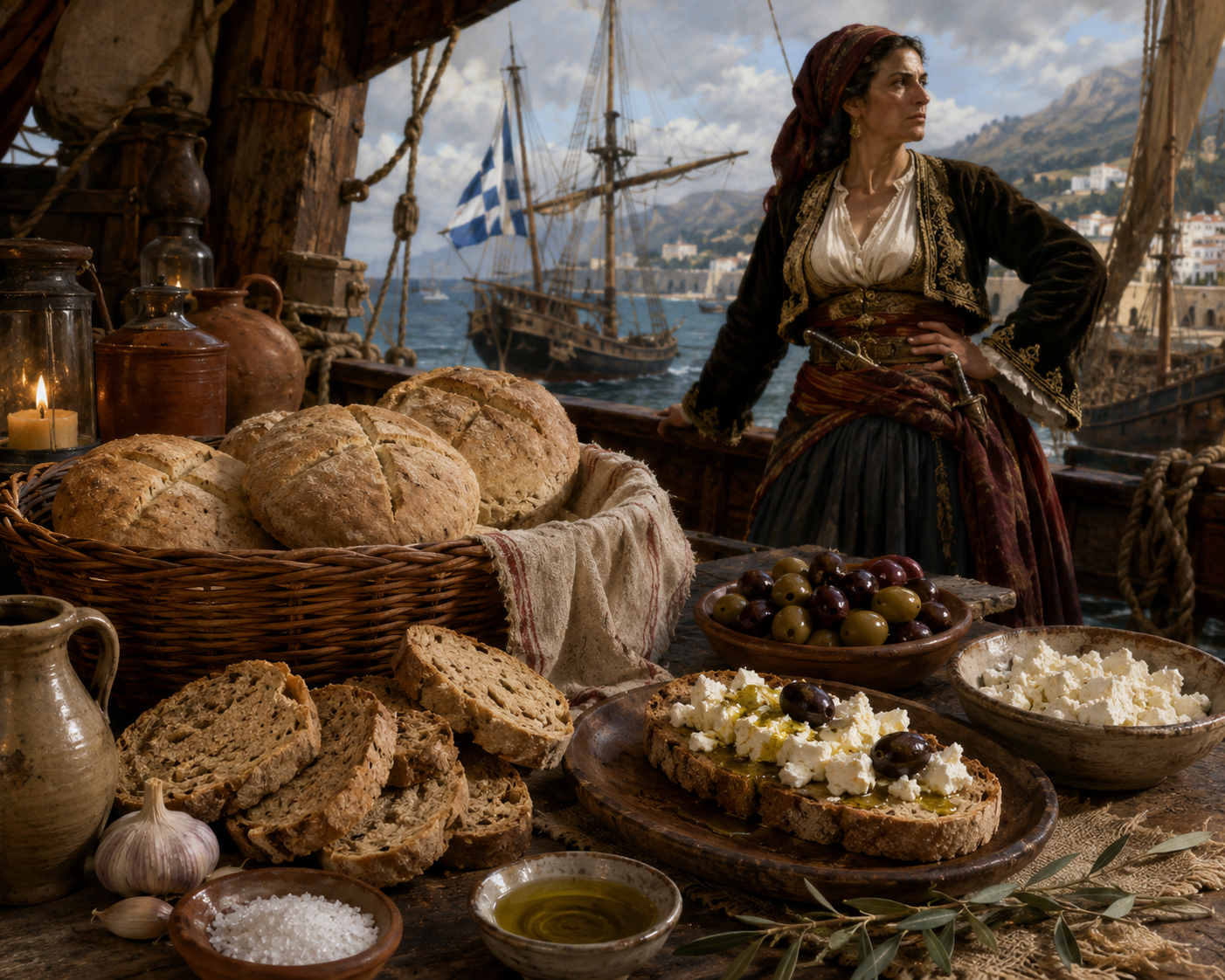
A very dry barley rusk, baked twice until hard as stone, which keeps indefinitely. On board, it was dipped in water, diluted wine, or oil, then topped with cheese and olives. It has been the fuel of Aegean sailors since antiquity.
Listen, you who have never seen the hold of a brig in bad weather. Soft bread molds before we round the cape; my men, instead, bit into barley paximádi, hard enough to break a tooth. We dipped it in a finger of water, drizzled it with my oil, a bit of feta on top, and there you have a full stomach to hold the blockade of Nafplio. A woman who feeds a hundred sailors quickly learns that a fleet's strength is also measured by what's in the biscuit chest.
- •Barley flour — the bulk of a mixing bowl (rustic and nourishing base)
- •A little wheat flour — a handful (dough binding)
- •Sourdough starter — a piece from the previous batch (slow leavening)
- •Water — as needed (binding)
- •Sea salt — a generous pinch (seasoning and preservation)
Paximádi — Sea Biscuit of Barley
A very dry barley rusk, baked twice until hard as stone, which keeps indefinitely. On board, it was dipped in water, diluted wine, or oil, then topped with cheese and olives. It has been the fuel of Aegean sailors since antiquity.
Why this dish? Bouboulina armed and commanded her own ships, including the corvette Agamemnon. On her vessels campaigning against the Ottomans, the crew did not eat fresh bread: they carried paximádi, this twice-baked barley biscuit that keeps for months in a damp hold. Softened with a little seawater or oil, it was the Greek sailor's staple — and therefore the staple of her fleet.
Listen, you who have never seen the hold of a brig in bad weather. Soft bread molds before we round the cape; my men, instead, bit into barley paximádi, hard enough to break a tooth. We dipped it in a finger of water, drizzled it with my oil, a bit of feta on top, and there you have a full stomach to hold the blockade of Nafplio. A woman who feeds a hundred sailors quickly learns that a fleet's strength is also measured by what's in the biscuit chest.
Ingredients (period version)
- Barley flour — the bulk of a mixing bowl (rustic and nourishing base)
- A little wheat flour — a handful (dough binding)
- Sourdough starter — a piece from the previous batch (slow leavening)
- Water — as needed (binding)
- Sea salt — a generous pinch (seasoning and preservation)
Ingredients
- Barley flour — 300 g (base)
- Whole wheat flour — 150 g (binding)
- Active sourdough (or 5 g dry yeast) — 100 g (leavening)
- Warm water — 260 ml approx. (hydration)
- Salt — 8 g (flavor)
- Olive oil — 2 tbsp (softness and preservation)
Method
- Mix the flours, salt, sourdough, and water; knead into a firm dough. Let rise 2–3 hours.
- Shape into round, flat loaves, score a cross on top, then bake at 200 °C for about 30 minutes until nicely crusted.
- Remove the loaves, let cool slightly, then slice them in half horizontally.
- Return the slices to the oven at 100–120 °C for 2–3 hours: this second baking dehydrates them and makes them imperishable.
- Store away from moisture. To serve, dip for a few seconds in water, drizzle with olive oil, and top with feta and olives.
How it was made : Paximádi (named after the Byzantine baker Paxamos) is attested since Greek antiquity and was the sea biscuit of the entire Mediterranean. On the islands, communal ovens baked huge batches of barley, a more rustic and cheaper grain than wheat, which was then re-baked for the navy and long voyages.
The contemporary twist : Served as dáko: moistened paximádi, rubbed with garlic, topped with grated tomato (a late 19th-century touch), crumbled feta, oregano, and a drizzle of oil. The sailor's snack becomes a terrace meze.
Sources : Andrew Dalby, Siren Feasts: A History of Food and Gastronomy in Greece · Diane Kochilas, The Greek Vegetarian / Ikaria
Laskarina Bouboulina · Charactorium