 flip
flipTuttmaç
Tuttmaç
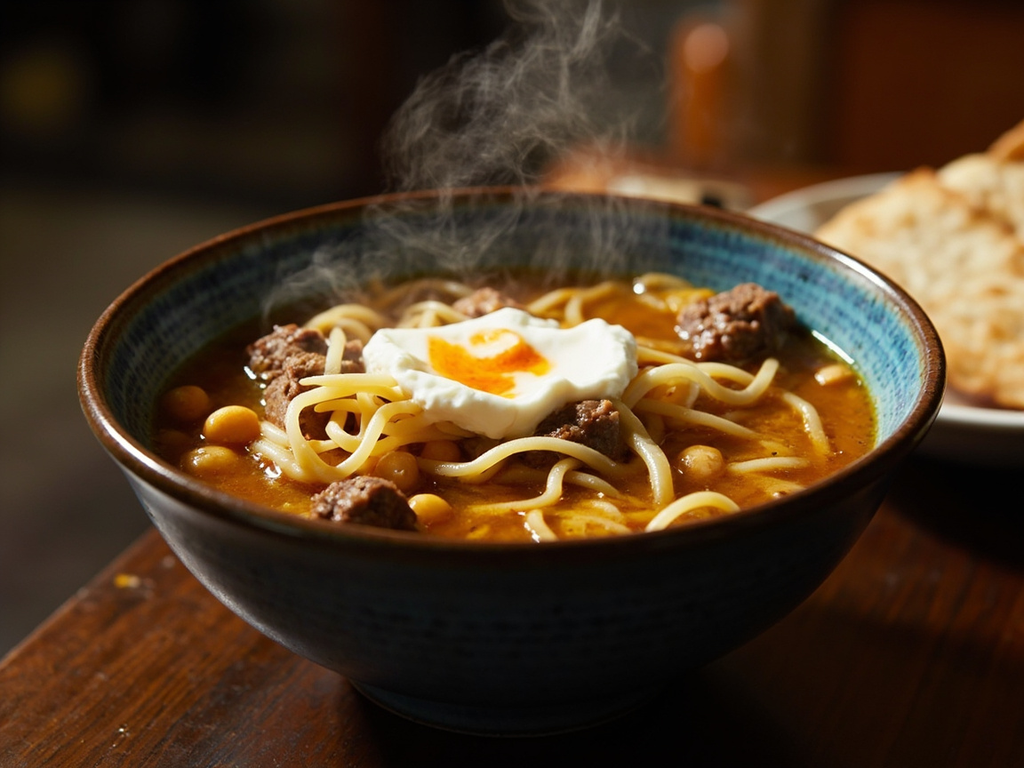
Why this dish? Tuttmaç is explicitly mentioned in the Dîwân Lughât al-Turk, where al-Kashgari defines it as a dish of boiled noodles. It is one of the few dishes that the philologist himself named and described in his encyclopedic work, proof of its importance in daily Turkish diet in the 11th century.
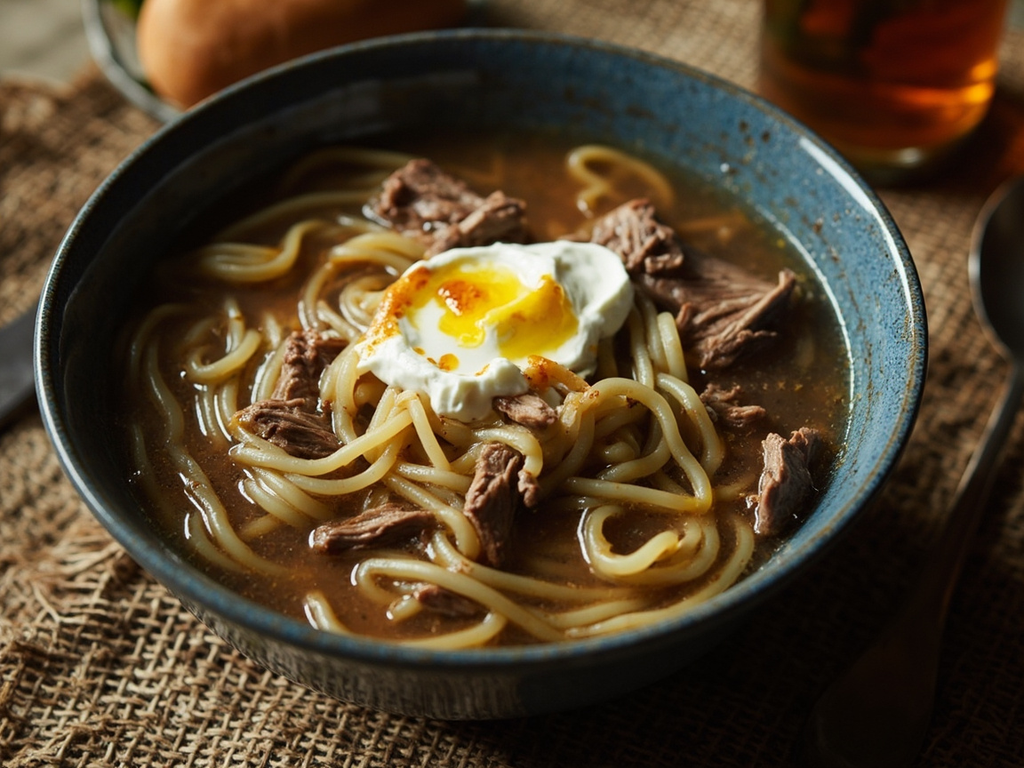
A thick soup of hand-cut noodles, served in a fragrant mutton broth, topped with sour yogurt and melted fat. A staple dish in the sedentary Turkish homes of Kashgar, tuttmaç is the direct ancestor of Central Asian lagman.
Know, you who read these lines, that among all the dishes of the Turkish peoples I have recorded, tuttmaç is the one found from Kashgar to Balasaghun, on every sofra. My mother prepared it by stretching the dough on a walnut board, then cutting it with a knife into strips that she threw into the steaming mutton broth. Sour yogurt and melted tail fat are poured over it — that is how men of letters and shepherds alike eat it. I recorded this word, tuttmaç, because it is ancient and pure, and it alone says what the Turks are: a people who know how to nourish with little.
- •Wheat flour — two generous handfuls (base of the noodle dough)
- •Water — as needed to bind (hydrating the dough)
- •Salt — a pinch (seasoning)
- •Mutton on the bone — one shoulder piece (broth and garnish)
- •Onion — one, chopped (broth aromatic)
- •Fat-tailed sheep tail fat — one piece, melted (finishing)
- •Sour yogurt — one bowl (acidic topping)
Tuttmaç
A thick soup of hand-cut noodles, served in a fragrant mutton broth, topped with sour yogurt and melted fat. A staple dish in the sedentary Turkish homes of Kashgar, tuttmaç is the direct ancestor of Central Asian lagman.
Why this dish? Tuttmaç is explicitly mentioned in the Dîwân Lughât al-Turk, where al-Kashgari defines it as a dish of boiled noodles. It is one of the few dishes that the philologist himself named and described in his encyclopedic work, proof of its importance in daily Turkish diet in the 11th century.
Know, you who read these lines, that among all the dishes of the Turkish peoples I have recorded, tuttmaç is the one found from Kashgar to Balasaghun, on every sofra. My mother prepared it by stretching the dough on a walnut board, then cutting it with a knife into strips that she threw into the steaming mutton broth. Sour yogurt and melted tail fat are poured over it — that is how men of letters and shepherds alike eat it. I recorded this word, tuttmaç, because it is ancient and pure, and it alone says what the Turks are: a people who know how to nourish with little.
Ingredients (period version)
- Wheat flour — two generous handfuls (base of the noodle dough)
- Water — as needed to bind (hydrating the dough)
- Salt — a pinch (seasoning)
- Mutton on the bone — one shoulder piece (broth and garnish)
- Onion — one, chopped (broth aromatic)
- Fat-tailed sheep tail fat — one piece, melted (finishing)
- Sour yogurt — one bowl (acidic topping)
Ingredients
- All-purpose flour — 300 g (base of the dough)
- Warm water — 130 ml (hydration)
- Salt — 1 tsp (seasoning dough and broth)
- Egg — 1 (binder (modern adaptation))
- Lamb neck or shoulder on the bone — 500 g (broth)
- Yellow onion — 1 medium (aromatic)
- Cold water — 1.5 liters (broth)
- Full-fat plain yogurt — 200 g (topping)
- Butter or lamb fat — 30 g (melted finish)
- Dried mint — 1 tsp (garnish)
Method
- Prepare the dough: mix flour, salt, egg, and warm water. Knead 8-10 minutes until a smooth ball forms. Cover with a cloth and let rest 30 minutes.
- Prepare the broth: place the lamb on the bone in a pot with cold water and the onion cut into quarters. Bring to a boil, skim, then simmer on low heat for 1 hour until the meat falls off the bone.
- Remove the meat, shred into pieces. Strain the broth and return it to the heat.
- Roll out the dough thinly (2 mm) on a floured surface. Cut into strips about 1 cm wide and 5 cm long.
- Bring the broth to a simmer and cook the noodles for 5-7 minutes until they float to the surface.
- Divide the noodles and broth into bowls, add the shredded meat.
- Top each bowl with a generous spoonful of yogurt. Melt the butter and drizzle over. Sprinkle with dried mint. Serve immediately.
How it was made : The word tuttmaç appears in the Dîwân Lughât al-Turk (1072-1074) as a boiled noodle dish specific to the Turkish peoples. The dough was stretched or cut by hand, without egg. The topping of sour yogurt and melted tail fat is attested in medieval Turkish food practices. This dish is the ancestor of the lagman and tututmaş still cooked in Uzbekistan, Kyrgyzstan, and Xinjiang.
The contemporary twist : Serve in a cobalt blue ceramic bowl reminiscent of Kashgar faience, with a spiral of browned butter on the yogurt.
Sources : Mahmoud al-Kashgari, Dîwân Lughât al-Turk (1072-1074), ed. Dankoff & Kelly, Harvard, 1982-1985 · Paul D. Buell, Eugene N. Anderson, Charles Perry, A Soup for the Qan: Chinese Dietary Medicine of the Mongol Era, Brill, 2010
Mahmoud al-Kashgari · Charactorium