 flip
flipChristmas Roast Goose with Red Cabbage (Gänsebraten mit Rotkohl)
Christmas Roast Goose with Red Cabbage (Gänsebraten mit Rotkohl)
Why this dish? The Christmas goose is THE festive dish of 19th-20th century German Protestant families, Planck's exact milieu, from a line of Lutheran pastors and jurists. A convivial meal around which his large family gathered.
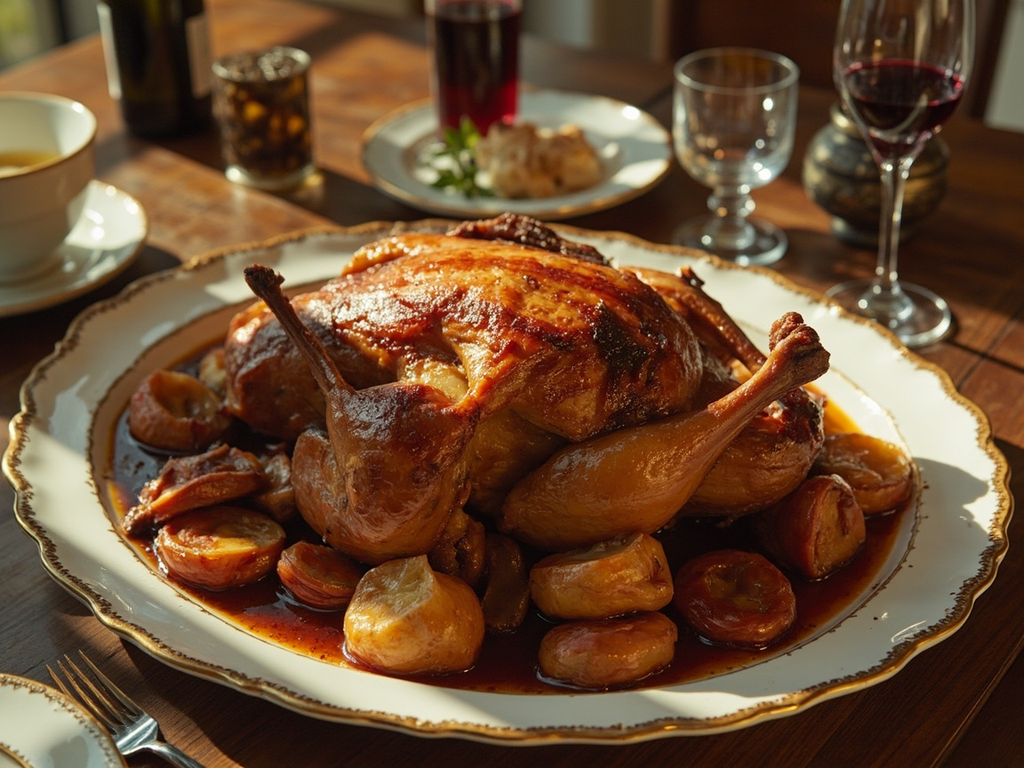
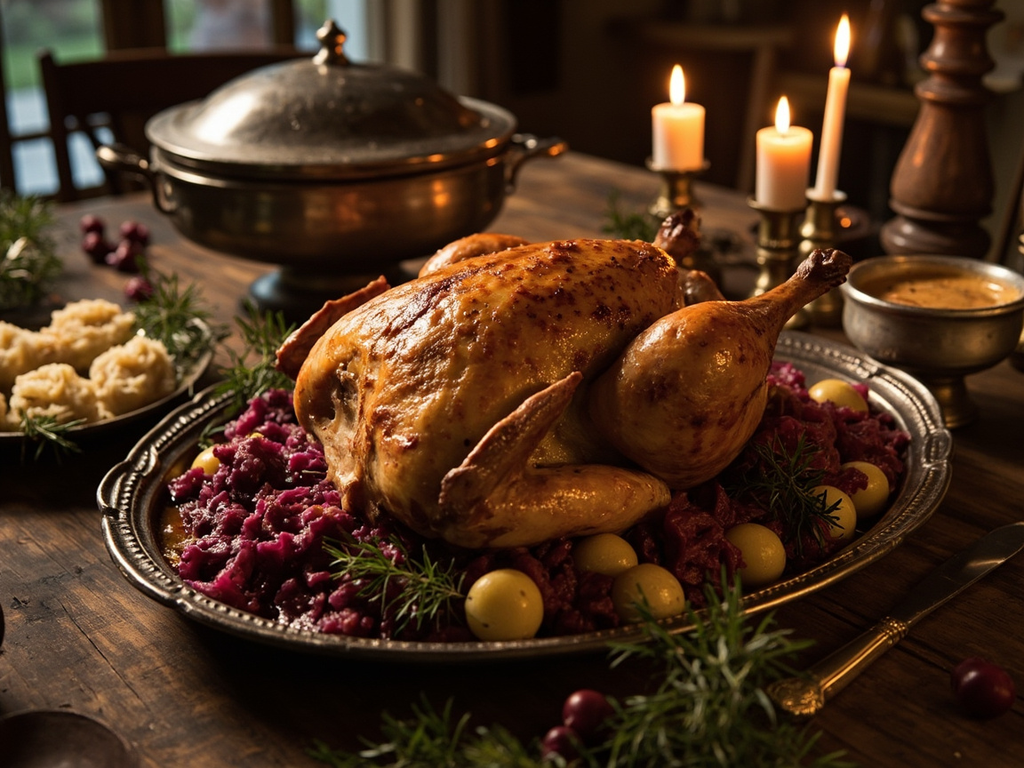
Golden, crispy goose stuffed with apples and chestnuts, accompanied by red cabbage braised with apples and cloves, and potato dumplings (Klöße). The quintessential festive dish of northern Germany.
At Christmas, the whole household gathered, and the goose reigned at the centre of the table like an immutable certainty. My mother made sure the skin was crispy and the flesh not dry — a balance as delicate as a well-posed equation. We basted it patiently with its own juices, served the steaming red cabbage and Klöße, and sang after the meal, for no celebration went without music in our home. Those were, you see, hours of peace that the rest of the century made infinitely precious to me.
- •Farm goose — one, plump (centrepiece)
- •Tart apples — several (stuffing and cabbage)
- •Chestnuts — a good handful (stuffing)
- •Red cabbage — one head (side dish)
- •Vinegar, cloves, bay leaf — to taste (braising the cabbage)
- •Potatoes — as desired (Klöße)
- •Marjoram and wormwood — a little (goose herbs)
Christmas Roast Goose with Red Cabbage (Gänsebraten mit Rotkohl)
Golden, crispy goose stuffed with apples and chestnuts, accompanied by red cabbage braised with apples and cloves, and potato dumplings (Klöße). The quintessential festive dish of northern Germany.
Why this dish? The Christmas goose is THE festive dish of 19th-20th century German Protestant families, Planck's exact milieu, from a line of Lutheran pastors and jurists. A convivial meal around which his large family gathered.
At Christmas, the whole household gathered, and the goose reigned at the centre of the table like an immutable certainty. My mother made sure the skin was crispy and the flesh not dry — a balance as delicate as a well-posed equation. We basted it patiently with its own juices, served the steaming red cabbage and Klöße, and sang after the meal, for no celebration went without music in our home. Those were, you see, hours of peace that the rest of the century made infinitely precious to me.
Ingredients (period version)
- Farm goose — one, plump (centrepiece)
- Tart apples — several (stuffing and cabbage)
- Chestnuts — a good handful (stuffing)
- Red cabbage — one head (side dish)
- Vinegar, cloves, bay leaf — to taste (braising the cabbage)
- Potatoes — as desired (Klöße)
- Marjoram and wormwood — a little (goose herbs)
Ingredients
- Goose — 1 (4-5 kg) (centrepiece)
- Reinette apples — 4 (stuffing and cabbage)
- Cooked chestnuts — 300 g (stuffing)
- Red cabbage — 1 (approx. 1 kg) (side dish)
- Red wine vinegar — 5 tbsp (cabbage acidity)
- Cloves + 1 bay leaf — 4 cloves (spices)
- Floury potatoes — 1 kg (Klöße)
- Dried marjoram, salt, pepper — to taste (seasoning)
Method
- Salt the inside of the goose, rub with marjoram, stuff with apple wedges and chestnuts.
- Prick the skin, place on a rack over a roasting pan and roast at 160°C for about 3 hours, basting regularly with the rendered fat.
- Shred the red cabbage, braise gently with grated apple, vinegar, cloves, bay leaf and a little sugar for 1 hour.
- Cook the potatoes, mash them, form dumplings (Klöße) and poach in simmering water until they float.
- Increase the oven to 220°C at the end of roasting to crisp the skin.
- Carve the goose, drizzle with degreased juices, serve with red cabbage and Klöße.
How it was made : Gänsebraten dates back to a tradition associated with St. Martin's Day (11 November) and later became anchored at Christmas. The vinegar-and-apple braised cabbage balanced the goose's fat; potato Klöße became widespread in central and northern Germany in the 19th century.
The contemporary twist : Glaze the goose at the end of cooking with a honey-dark beer mixture for an amber, shiny skin, like stained glass.
Max Planck · Charactorium