 flip
flipHerbed Barley Pottage (Gerstenmus)
Herbed Barley Pottage (Gerstenmus)
Why this dish? This was the everyday dish on a Beguine's frugal table: a thick, nourishing barley pottage, bound with fresh cheese and scented with herbs picked from the convent garden in Magdeburg.
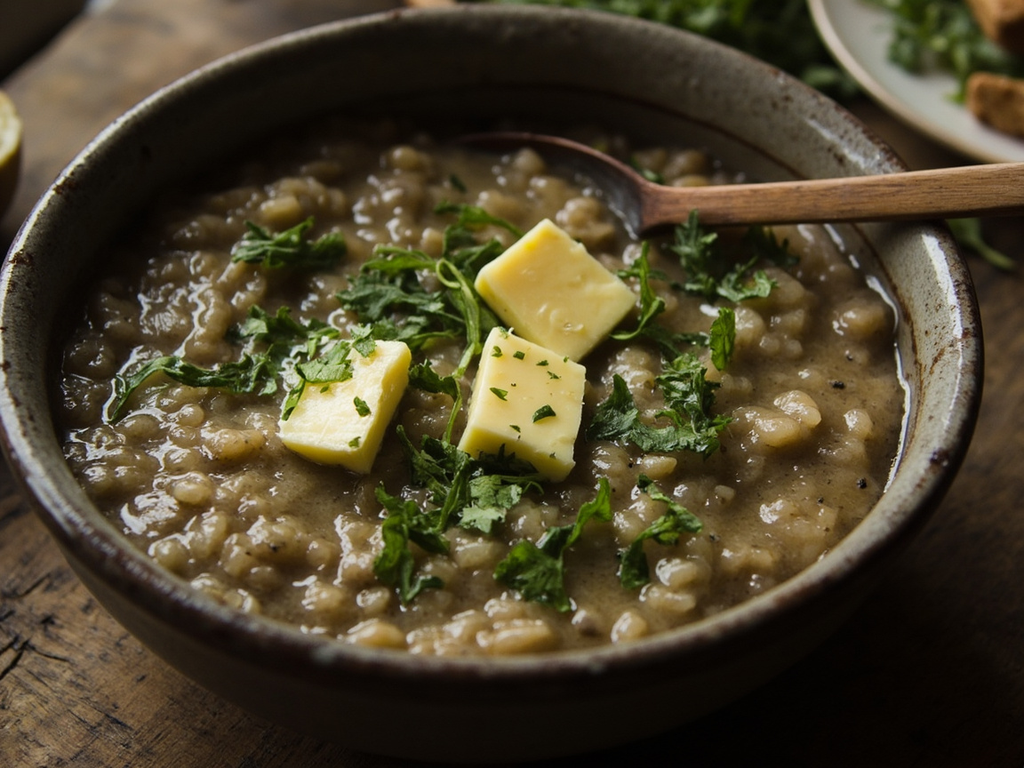
A barley porridge simmered until velvety, enriched with a little fresh cheese and green herbs from the garden (parsley, lovage). Simple, warm, comforting—the daily food of the cloister.
You who read me, do not scorn this unadorned dish: it was the moistened bread of my silent days. I rinsed the barley in cold water, let it soften all day, then over a gentle fire I stirred, and stirred again, until it opened like a patient soul. I mixed in my handful of lovage and a little cheese, and I ate with eyes lowered, for Our Lord also hides in the measure of a poor meal. Blessed be the spoon that satisfies without flattering the tongue.
- •Hulled barley — two handfuls (nourishing base)
- •Water or whey — as needed (cooking liquid)
- •Fresh cheese — a little (creamy binder)
- •Parsley and lovage from the garden — a handful (green fragrance)
- •Butter — a knob (richness)
- •Salt — a pinch (seasoning)
Herbed Barley Pottage (Gerstenmus)
A barley porridge simmered until velvety, enriched with a little fresh cheese and green herbs from the garden (parsley, lovage). Simple, warm, comforting—the daily food of the cloister.
Why this dish? This was the everyday dish on a Beguine's frugal table: a thick, nourishing barley pottage, bound with fresh cheese and scented with herbs picked from the convent garden in Magdeburg.
You who read me, do not scorn this unadorned dish: it was the moistened bread of my silent days. I rinsed the barley in cold water, let it soften all day, then over a gentle fire I stirred, and stirred again, until it opened like a patient soul. I mixed in my handful of lovage and a little cheese, and I ate with eyes lowered, for Our Lord also hides in the measure of a poor meal. Blessed be the spoon that satisfies without flattering the tongue.
Ingredients (period version)
- Hulled barley — two handfuls (nourishing base)
- Water or whey — as needed (cooking liquid)
- Fresh cheese — a little (creamy binder)
- Parsley and lovage from the garden — a handful (green fragrance)
- Butter — a knob (richness)
- Salt — a pinch (seasoning)
Ingredients
- Pearl barley — 200 g (nourishing base)
- Vegetable broth — 1 L (cooking liquid)
- Fresh cheese (e.g., fromage frais) — 100 g (creamy binder)
- Flat-leaf parsley — 1 small bunch (green fragrance)
- Lovage (or celery stalks if unavailable) — 2 tbsp chopped (green fragrance)
- Butter — 20 g (richness)
- Salt — to taste (seasoning)
Method
- Rinse the pearl barley in cold water.
- Pour it into the cold broth and bring gently to a simmer.
- Cook over very low heat for 40–50 minutes, stirring regularly, until thick and creamy.
- Off the heat, stir in the butter, then the fresh cheese to bind.
- Add the chopped parsley and lovage, season with salt, and serve hot in a bowl.
How it was made : Grain porridges (mus, brei) were the backbone of monastic diet. They were cooked for hours in a cauldron hung from the chimney hook, barley being a humble grain compared to wheat reserved for bread. Herbs came from the hortus, the walled garden cultivated by the community.
The contemporary twist : Top with grated aged mountain cheese melted like a risotto, and a sprinkle of fresh herbs for contrast.
Sources : Rule of Saint Benedict, ch. 39 (On the Measure of Food) · Hildegard of Bingen, Physica (virtues of grains and herbs)
Mechthild of Magdeburg · Charactorium