 flip
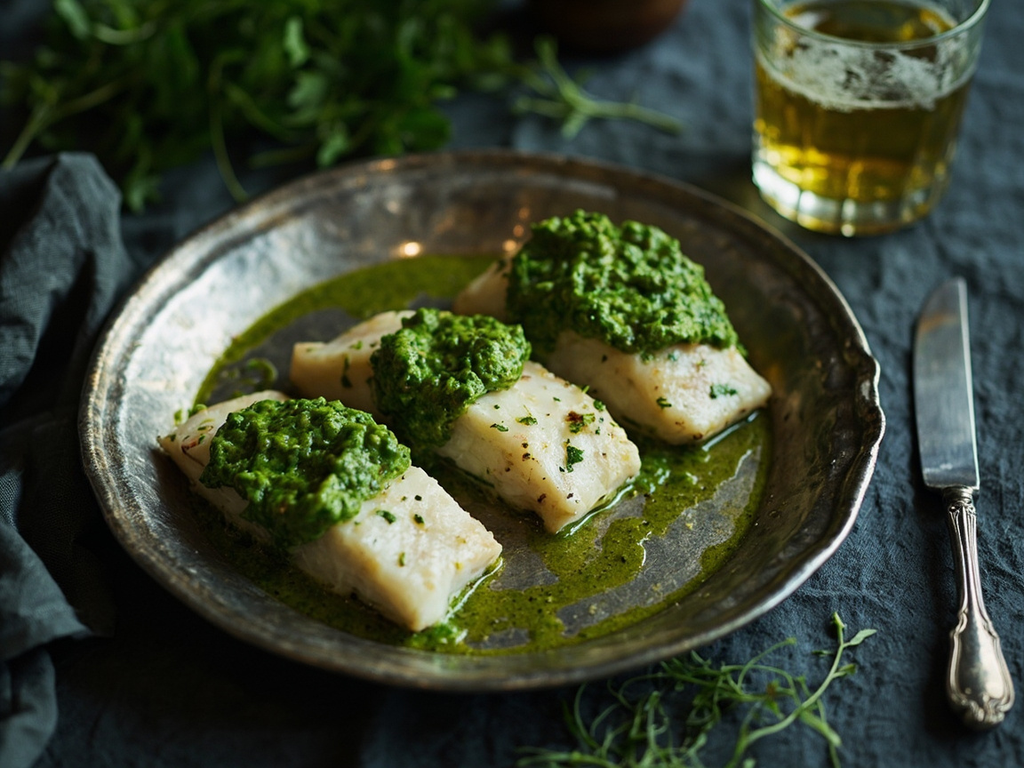
flipPike in Green Sauce (Hecht in grüner Soße)
Pike in Green Sauce (Hecht in grüner Soße)
Why this dish? On meatless days, frequent under the Rule, fish from the Elbe and convent ponds became a celebration: a pike caught in the Magdeburg river, coated with a vivid green sauce made from cloister herbs.
Poached river fish, served cold or warm under a medieval green sauce bound with breadcrumbs, sharpened with verjuice and scented with parsley and mint. The meatless-day dish elevated to a small solemnity.
On days when the Rule forbade us flesh, fish was like a sweet permission. They brought the wriggling pike from the fishponds, and I ground in the mortar the parsley and mint with the bread soaked in verjuice, until I had a sauce green as April meadows. See, the acid awakens the tongue weary from fasting, and it seemed to me that this freshness spoke of the joy hidden under abstinence. Eat it on Lenten days, and give thanks.
- •River pike — one fish (centerpiece)
- •Parsley, mint, chervil — a large handful (green sauce base)
- •Verjuice — to eye (acidity)
- •Breadcrumbs — a soaked crust (binder)
- •Salt and pepper — as needed (seasoning)
Pike in Green Sauce (Hecht in grüner Soße)
Poached river fish, served cold or warm under a medieval green sauce bound with breadcrumbs, sharpened with verjuice and scented with parsley and mint. The meatless-day dish elevated to a small solemnity.
Why this dish? On meatless days, frequent under the Rule, fish from the Elbe and convent ponds became a celebration: a pike caught in the Magdeburg river, coated with a vivid green sauce made from cloister herbs.
On days when the Rule forbade us flesh, fish was like a sweet permission. They brought the wriggling pike from the fishponds, and I ground in the mortar the parsley and mint with the bread soaked in verjuice, until I had a sauce green as April meadows. See, the acid awakens the tongue weary from fasting, and it seemed to me that this freshness spoke of the joy hidden under abstinence. Eat it on Lenten days, and give thanks.
Ingredients (period version)
- River pike — one fish (centerpiece)
- Parsley, mint, chervil — a large handful (green sauce base)
- Verjuice — to eye (acidity)
- Breadcrumbs — a soaked crust (binder)
- Salt and pepper — as needed (seasoning)
Ingredients
- Pike or zander fillets — 600 g (centerpiece)
- Court-bouillon (water, salt, herbs) — 1.5 L (poaching)
- Flat-leaf parsley — 1 large bunch (green sauce base)
- Fresh mint — 6 leaves (freshness)
- Chervil — 1/2 bunch (fragrance)
- Verjuice (or green grape juice + splash of vinegar) — 4 tbsp (acidity)
- Stale breadcrumbs — 30 g, soaked then squeezed (binder)
- Salt and pepper — to taste (seasoning)
Method
- Prepare a court-bouillon and poach the fish fillets for 6–8 minutes at a simmer. Keep warm.
- Soak the breadcrumbs in verjuice.
- In a mortar or blender, grind the herbs with the squeezed breadcrumbs and verjuice to a thick green sauce.
- Thin with a little court-bouillon if needed; season with salt and pepper.
- Arrange the fish, spoon the green sauce over, and serve warm or at room temperature.
How it was made : Green sauce (grüne Soße, green-meadow sauce) is a major medieval European sauce: herbs were pounded in a mortar with soaked bread to bind, and acidity came from verjuice—the juice of unripe green grapes—since lemons were rare in the north. Freshwater fish, raised in monastic fishponds, was central on the many meatless days.
The contemporary twist : Serve as pearly fillets on a slate board, with the green sauce in an emerald swoosh and a few herb shoots—a nod to Grüne Soße, still an emblem of Hessian cuisine.
Sources : Daz Buoch von guoter Spise (German culinary collection, c. 1350) · Rule of Saint Benedict, ch. 39 (abstinence from the flesh of quadrupeds)
Mechthild of Magdeburg · Charactorium