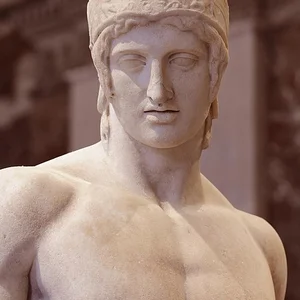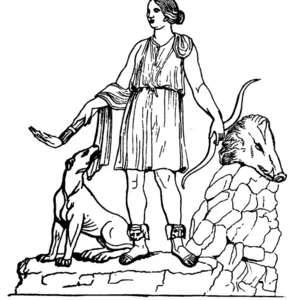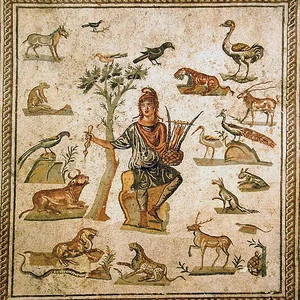

Legendary musician and poet of Greek mythology, son of Apollo and the Muse Calliope. He is famous for his magical lyre whose music enchanted gods, mortals, and nature alike. His love for Eurydice and his descent into the Underworld make up one of the greatest myths of Antiquity.
Orpheus
Orpheus
8 min read
Frequently asked questions
Key Facts
- A gifted musician with a magical lyre given to him by Apollo, capable of charming all living beings with his music
- He attempted to descend into the Underworld to bring back his wife Eurydice, who had been bitten by a snake on their wedding day
- He obtained permission from Hades and Persephone to bring Eurydice back, on the condition that he not look back before leaving the Underworld
- He failed by turning around before reaching the exit, losing Eurydice forever
- The myth was popularized by Ovid in the Metamorphoses and has inspired the arts across the centuries
Works & Achievements
A mythical instrument crafted by Hermes and given to Orpheus, whose music had the power to enchant gods, men, animals, and even nature itself. It is Orpheus's defining emblem and the symbol of music's supreme power.
Orpheus took part in this legendary quest alongside Jason to win the Golden Fleece. His role was crucial: his music calmed storms and guided the heroes through countless dangers.
The founding myth in which Orpheus descends into the Underworld with his lyre to bring back his beloved Eurydice. Though doomed to fail by the prohibition against looking back, this tale illustrates the power of love and music in the face of fate.
A body of poetic and religious traditions attributed to Orpheus, which gave rise to mystical and ritual practices. These teachings represent an early form of Greek religious philosophy that profoundly influenced the mystery cults.
During the Argonauts' expedition, Orpheus used his music to drive away the Harpies that tormented the seer Phineus, demonstrating his lyre's absolute power over supernatural creatures.
According to certain traditions, Orpheus is said to have passed on or influenced the mystical rituals of Eleusis, contributing to the establishment of one of ancient Greece's most important religious practices.
Anecdotes
According to Greek mythology, Orpheus took part in the Argonauts' expedition alongside Jason to win the Golden Fleece. His magical lyre saved his companions by drowning out the deadly song of the Sirens, sea creatures whose voices could hypnotize sailors. This story shows how the ancient Greeks wove Orpheus into their great epic myths.
The myth of Orpheus and Eurydice is one of the most celebrated love stories of antiquity. After Eurydice's death, Orpheus descended into the Underworld with his lyre to bring her back, and his music moved even Hades and Persephone. Tragically, he could not resist looking back before leaving the Underworld, losing his love forever.
Ancient Greek poets, such as Ovid in his Metamorphoses, described Orpheus's lyre as so powerful it could charm wild beasts, halt rivers in their course, and stir the very rocks. This imagery underscores the symbolic importance of music and poetry in ancient Greek culture.
According to some mythological accounts, Orpheus founded religious mysteries and Dionysian cults in Thrace, his homeland. His religious and spiritual influence in mythology makes him far more than a mere musician — he was a true sage and prophet revered throughout the ancient Greek world.
The figure of Orpheus inspired countless adaptations in ancient literature: Virgil, Ovid, and the Greek playwrights all immortalized him. The myth's enduring presence in ancient texts shows how deeply Orpheus embodied Greek ideals of beauty, love, and the power of the spoken word.
Primary Sources
Orpheus, whose lyre enchanted wild beasts and trees, descended to the Underworld to seek his wife Eurydice. But by turning back before leaving the realm of the dead, he lost her forever.
Orpheus, son of Apollo, whose voice and lyre surpassed all others, loved Eurydice deeply. When she died from a serpent's bite, he descended alive into the Underworld — the only mortal ever to enter it that way.
Apollo fathered Orpheus, and Orpheus surpassed all men in the art of music and poetry.
Orpheus, the poet with the divine lyre, set sail with Jason and the Argonauts. His music calmed the seas and enchanted even the most savage creatures.
Orpheus, whose music could move even stones, managed to soften the hearts of Hades and Persephone, who agreed to return Eurydice on the condition that he not look back while ascending from Tartarus.
Key Places
A region of northern ancient Greece, considered the homeland of Orpheus in Greek mythology. It was here that he grew up and developed his exceptional musical talents.
A mountain in Thrace where Orpheus is said to have retreated after the death of Eurydice, pouring out his grief through music that enchanted the surrounding nature.
The subterranean kingdom of the dead in Greek mythology, where Orpheus descended with his lyre in an attempt to bring Eurydice back, enchanting Hades and Persephone with his music.
A region of the Caucasus where Orpheus traveled as a member of the Argonauts' expedition with Jason, using his music to inspire and guide his companions.
A region of Macedonia in northern Greece, connected to Orpheus through its proximity to Mount Olympus and associated with the cult of Apollo, whom mythology identifies as his father.
A Greek island where, according to some versions of the myth, Orpheus's body washed ashore after his death, his severed head retaining a prophetic voice.
Typical Objects

A stringed instrument emblematic of Orpheus. It was with his magical lyre that Orpheus enchanted gods, humans, and nature alike through the beauty of his music.
📷 CC BY-SA 4.0 · Wikimedia Commons ↗
A small pointed tool used to pluck the strings of the lyre. Orpheus used it to play his mythic instrument and create his extraordinary melodies.

A wreath of leaves symbolizing poetic and musical victory. It represents the glory of Orpheus as the greatest musician of ancient Greece.
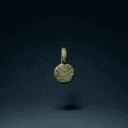
A magical protective object typical of ancient Greece. Orpheus, son of Apollo, was associated with magical powers and objects endowed with supernatural virtues.
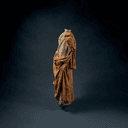
The traditional tunic and cloak (himation) worn by poets and musicians of ancient Greece. As a legendary bard, Orpheus embodied the image of the ancient poet.

A precious ornamental object worn by nobles and artists of ancient Greece. It symbolizes the privileged status of Orpheus as the son of an Olympian god.
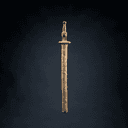
A writing medium used in antiquity to preserve texts and songs. The poems and legends of Orpheus would have been passed down on such materials.

A source of light used during Orpheus's mythic descent into the Underworld. It symbolizes the crossing between the world of the living and the realm of the dead in his quest for Eurydice.
📷 CC BY-SA 4.0 · Wikimedia Commons ↗School Curriculum
Vocabulary & Tags
Key Vocabulary
Daily Life
Morning
Orpheus wakes at dawn in his home in Thrace and begins by tuning his lyre, the sacred instrument inherited from his father Apollo. He performs a ritual purification in a cold spring — a common practice among musicians and poets of ancient Greece, who viewed body and mind as deeply connected.
Afternoon
In the afternoons, Orpheus composes new songs and poems, or withdraws to natural settings such as forests and riverbanks for inspiration. According to mythological tradition, his music draws wild animals near and enchants nature itself, reflecting the poet's role as a bridge between the divine and the earthly.
Evening
At sunset, Orpheus attends banquets and religious ceremonies where his music is called upon to honor the gods. He performs before nobles and assemblies, often accompanying sacred rituals and celebrations — the prestigious role of the rhapsode in ancient Greece.
Food
Orpheus follows the typical Mediterranean diet of ancient Greece: barley bread, fruits (figs, grapes), vegetables, cheese, and occasional fish. As a high-status musician, he enjoys more generous portions at the feasts to which he is invited, including sacrificial meat and wine diluted with water according to Greek custom.
Clothing
Orpheus wears a simple tunic (chiton) of linen or wool, complemented by an elegantly draped cloak (himation) — attire befitting a prestigious poet and musician. He is typically depicted with long hair, carrying or holding his lyre, the defining attributes of a musician in Greek iconography.
Housing
Orpheus likely lives in a notable residence in Thrace or Thessaly, a region renowned for its musicians. His home would have featured a main hall where he receives apprentices and visitors, with a space dedicated to music and poetry — a reflection of the elevated social standing of the poet in ancient Greek society.
Historical Timeline
Period Vocabulary
Visual Style
Un style combinant l'élégance des poteries grecques antiques avec une atmosphère mystique et dramatique, où la lumière dorée divine crée des contrastes entre le monde des vivants et les ténèbres de l'Au-delà. Les lignes épurées du dessin grec côtoient des jeux d'ombre romantiques pour souligner la puissance magique et émotionnelle du personnage.
Sound Ambience
Une ambiance sonore envoûtante mêlant les notes mélodiques de la lyre antique à des éléments naturels délicats, créant une atmosphère à la fois divine et tragique, parfaite pour évoquer l'amour perdu d'Orphée et la magie de sa musique légendaire.
Liens externes & ressources
Références
Œuvres
La Lyre magique
inconnue
L'expédition des Argonautes
inconnue
La descente aux Enfers
inconnue
Les hymnes orphiques
inconnue
L'apaisement des Harpies
inconnue
La fondation des mystères d'Éleusis
inconnue