 flip
flipKokoda
Kokoda
Why this dish? On the island of Bau and throughout the archipelago, raw fish marinated in citrus juice and *lolo* was the daily fare of fishermen and families. Cakobau, though he was *Vunivalu* (supreme war chief), ate *kokoda* like all islanders — it was the food of the sea that surrounded his fortress-island.
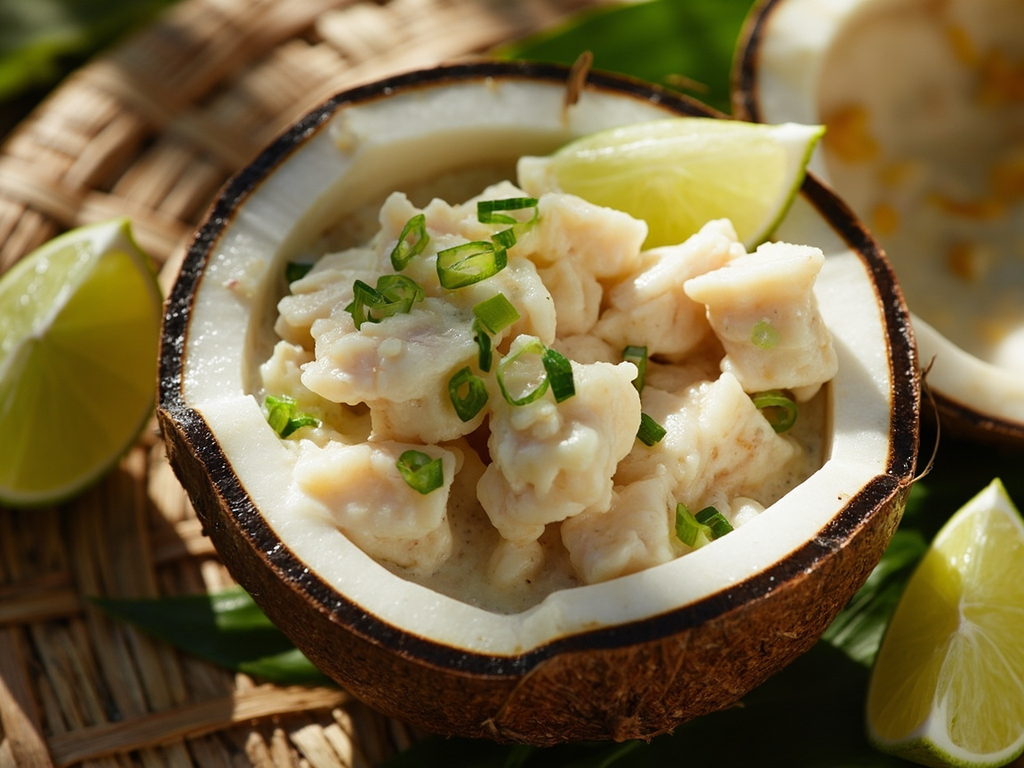
Raw fish diced, 'cooked' in lime juice then drenched in thick coconut cream. Fresh, bright, and creamy all at once, *kokoda* is the emblem of everyday Fijian cuisine.
Fish is the first gift of the sea to Bau. My fishermen would bring back *walu* or *saqa* still quivering, and the women would cut it with bamboo knives before bathing it in the juice of *moli*. Then came the *lolo*, thick as it should be. We ate this on the mat, without ceremony, between matters of state. A *Vunivalu* who does not know the taste of his lagoon does not deserve to rule it.
- •Fresh white fish (walu, saqa, or mahi-mahi) — One good fish (Base)
- •Limes (moli) — Several, very juicy (Acidic marinade)
- •Fresh coconut cream (lolo) — A good measure (Creaminess)
- •Wild onion or spring onion — A few stalks (Aromatic)
- •Sea salt — A pinch (Seasoning)
Kokoda
Raw fish diced, 'cooked' in lime juice then drenched in thick coconut cream. Fresh, bright, and creamy all at once, *kokoda* is the emblem of everyday Fijian cuisine.
Why this dish? On the island of Bau and throughout the archipelago, raw fish marinated in citrus juice and *lolo* was the daily fare of fishermen and families. Cakobau, though he was *Vunivalu* (supreme war chief), ate *kokoda* like all islanders — it was the food of the sea that surrounded his fortress-island.
Fish is the first gift of the sea to Bau. My fishermen would bring back *walu* or *saqa* still quivering, and the women would cut it with bamboo knives before bathing it in the juice of *moli*. Then came the *lolo*, thick as it should be. We ate this on the mat, without ceremony, between matters of state. A *Vunivalu* who does not know the taste of his lagoon does not deserve to rule it.
Ingredients (period version)
- Fresh white fish (walu, saqa, or mahi-mahi) — One good fish (Base)
- Limes (moli) — Several, very juicy (Acidic marinade)
- Fresh coconut cream (lolo) — A good measure (Creaminess)
- Wild onion or spring onion — A few stalks (Aromatic)
- Sea salt — A pinch (Seasoning)
Ingredients
- Very fresh white fish fillet (sea bream, sea bass, or cod) — 400 g (Base)
- Limes — 6 (Acidic marinade)
- Thick coconut cream — 200 ml (Creaminess)
- Tomato (optional — post-European contact addition) — 1 small (Freshness and color)
- Red onion — 1 small (Crunch and bite)
- Cucumber — 1/2 (Freshness)
- Fine salt — 1 tsp (Seasoning)
- Fresh coriander — A few leaves (Garnish)
Method
- Cut the fish into small dice about 1.5 cm. Check for bones.
- Juice the limes. Pour the juice over the fish in a bowl, mix, and cover. Refrigerate for 2 to 3 hours: the fish should become opaque and firm.
- Drain the fish, pressing lightly to remove excess juice.
- Slice the onion into thin rings, dice the cucumber, and brunoise the tomato.
- Mix the drained fish with coconut cream, onion, cucumber, and tomato. Season with salt.
- Serve very cold, ideally in a half coconut shell or bowl, garnished with coriander.
How it was made : *Kokoda* is attested throughout the Pacific in various forms (*oka* in Tonga, *ika mata* in the Cook Islands, Tahitian raw fish). Citrus fruits, probably introduced by early European navigators in the 18th century, were quickly integrated into local cuisine. Before limes, fish could be eaten raw plain or lightly fermented.
The contemporary twist : Present the *kokoda* in polished half coconut shells, with a swirl of coconut milk drizzled on top just before serving.
Sources : Helen Reeves, Traditional Fijian Food and Cooking, Fiji Museum, 2003 · Pollock, Nancy J., These Roots Remain: Food Habits in Islands of the Central and Eastern Pacific since Western Contact, University of Hawaii Press, 1992
Ratu Seru Cakobau · Charactorium