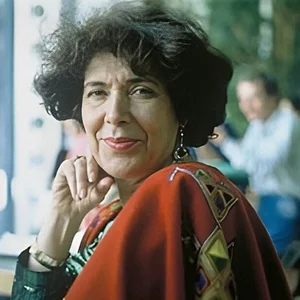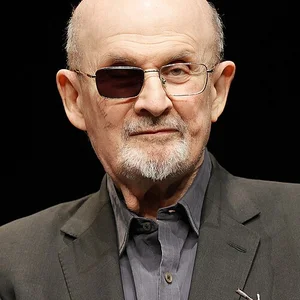

British-American writer of Indian origin born in 1947, a major figure in English-language postcolonial literature. Known worldwide for his novels blending magical realism with the history of India, as well as for the fatwa issued against him after the publication of The Satanic Verses.
Salman Rushdie(1947 — ?)
Salman Rushdie
États-Unis, Royaume-Uni, Inde
6 min read
Frequently asked questions
Key Facts
- Born on June 19, 1947, in Bombay (India), shortly before India's independence
- Published Midnight's Children in 1981, which won the Booker Prize
- Published The Satanic Verses in 1988, sparking an international controversy
- Targeted by a fatwa from Ayatollah Khomeini on February 14, 1989, forcing him to live in hiding for years
- Victim of a knife attack on August 12, 2022, during a lecture in New York State
Works & Achievements
A sweeping portrait of independent India blending history and magical realism. Awarded the Booker Prize, it is the work that established his worldwide fame.
A novel inspired by the political history of Pakistan, where satire mingles with the marvellous.
A novel about exile, faith and identity that triggered the 1989 fatwa and a worldwide debate on freedom of expression.
A tale written for his son while in hiding, defending the freedom to tell stories.
A family saga spanning a century of Indian history, praised by critics.
An account, written in the third person, of his years living in hiding under police protection.
A testimony about the 2022 attack and his recovery, a meditation on survival and creation.
Anecdotes
On February 14, 1989, Valentine's Day, Ayatollah Khomeini, Iran's religious leader, issued a “fatwa” sentencing Salman Rushdie to death because of his novel The Satanic Verses. For nearly ten years, the writer lived in hiding under police protection, constantly moving from one home to another to escape his enemies.
To stay invisible, Rushdie chose a fake name: Joseph Anton, formed from the first names of two writers he admired, Joseph Conrad and Anton Chekhov. His bodyguards simply called him “Joe.”
His novel Midnight's Children tells the story of children born at the exact moment of India's independence, at midnight on August 15, 1947, and gifted with magical powers. The book won the prestigious Booker Prize in 1981, and was later twice voted the “best Booker” in the prize's entire history.
During his years in hiding, Rushdie wrote Haroun and the Sea of Stories, a tale meant for his young son Zafar. The story takes place in a land where people try to silence the storytellers — a direct echo of his own situation.
On August 12, 2022, as he was about to give a lecture in Chautauqua, New York State, Rushdie was stabbed on stage by an assailant. He survived but lost the use of one eye, and would recount this ordeal in his book Knife, published in 2024.
Primary Sources
I inform all the proud Muslims of the world that the author of the book entitled The Satanic Verses, which is directed against Islam, the Prophet, and the Qur'an, along with all those who took part in its publication while being aware of its content, are sentenced to death.
A book is a version of the world. If you do not like it, ignore it, or offer your own version in return.
What is freedom of expression? Without the freedom to offend, it ceases to exist.
Later, when the world exploded around him and the murderous birds gathered on the climbing frame in the school playground, he resented his wife for breaking the news to him over the phone, without looking him in the eyes.
Key Places
Rushdie's birthplace, where he was born in 1947. This teeming Indian metropolis fed the imagination of several of his novels.
University where Rushdie studied history in the 1960s. It was there that he discovered the Quranic episode that would later inspire *The Satanic Verses*.
City where he settled and wrote his major novels, and where he lived in hiding under police protection after the 1989 fatwa.
City where Rushdie settled in the early 2000s to reclaim a freer, more public life.
Cultural center where Rushdie was stabbed on stage on August 12, 2022, as he was about to speak about protecting threatened writers.
Typical Objects

The novel published in 1988 that upended Rushdie's life. A focus of debates over freedom of expression and blasphemy, it was burned during demonstrations in several cities.

The writer's everyday working tools, on which he composed his novels. Rushdie kept writing even during his years in hiding.

The borrowed identity documents used while in hiding to conceal his true identity. The pseudonym combined the first names of Conrad and Chekhov.

A recognizable feature of his appearance; after the 2022 attack, he wears a blacked-out lens over the eye he lost.

The award given for Midnight's Children in 1981. The novel was later twice crowned the “Best of the Booker” in the prize's history.
School Curriculum
Vocabulary & Tags
Key Vocabulary
Tags
Daily Life
Morning
Like many writers, Rushdie likes to work in the morning, when his mind is fresh: he settles at his desk to write for several hours. He often aims for a daily target of pages or words before doing anything else.
Afternoon
The afternoon is devoted to reading, revising his texts, and exchanging with his editors. During his years in hiding, even the smallest outing had to be arranged in advance with his bodyguards.
Evening
In the evening, the writer happily takes part in dinners, literary discussions, or gatherings with friends from the world of letters. While in hiding, however, his public outings were nearly impossible and carefully controlled.
Food
A lover of both the Indian cuisine of his childhood and Western gastronomy, Rushdie enjoys shared, convivial meals. The food and flavors of Bombay often turn up in his novels.
Clothing
He dresses in contemporary city wear, a suit or casual clothes depending on the occasion. His glasses are part of his recognizable look, and today he wears a dark lens over the eye he lost.
Housing
A writer based in major cities such as London and later New York, he lives in urban apartments. Between 1989 and the late 1990s, on the contrary, he had to move constantly, from safe house to safe house, to escape the threats.
Historical Timeline
Period Vocabulary
Liens externes & ressources
Références
Œuvres
Les Enfants de minuit (Midnight's Children)
1981
La Honte (Shame)
1983
Les Versets sataniques (The Satanic Verses)
1988
Haroun et la mer des histoires (Haroun and the Sea of Stories)
1990
Le Dernier Soupir du Maure (The Moor's Last Sigh)
1995
Joseph Anton. Une autobiographie
2012
Le Couteau (Knife)
2024