 flip
flipVenison pasty with currants and sweet spices
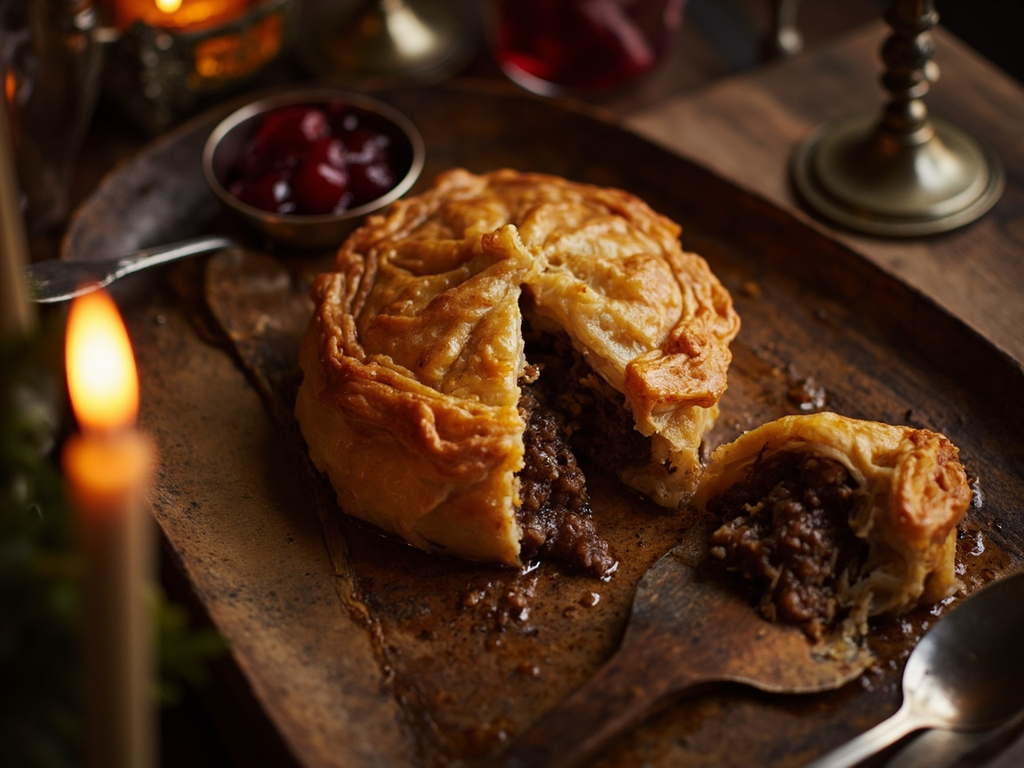
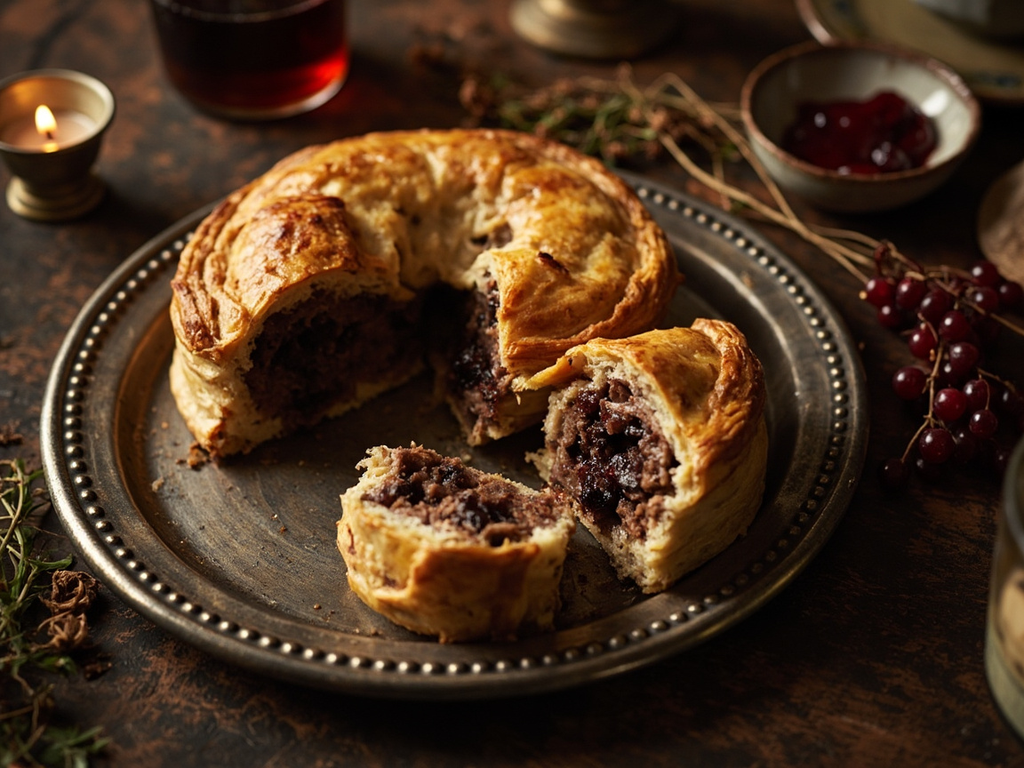
Venison pasty with currants and sweet spices
Why this dish? Hobbes spent most of his life in the service of the Cavendishes, Earls of Devonshire, whose parks at Hardwick and Chatsworth teemed with deer. Venison was the prestige meat par excellence: a game pie marked the great days of the household that employed him.
An imposing pie in a crust filled with spiced venison, enlivened with dried currants and a hint of sugar. The sweet-savoury-spiced marriage characteristic of noble English tables of the baroque era.
The deer, you see, is no market meat: it comes from a lord's park, and it is a favour to taste it. At my Lord of Devonshire's, one mortified the venison a few days, then laid it in a crust thick as a chest, with currants of Corinth, mace and a little sugar, for we loved that savoury and sweet should war in the mouth. One sealed the lid with melted butter to keep it good for long. Such a pasty, sir, is a little Leviathan: its crust is the rampart, and peace reigns within.
- •Venison (haunch of deer or roe deer) — a fine piece (meat)
- •Beef fat (suet) — a piece (moisture)
- •Dried currants (Corinth) — a handful (fruity sweetness)
- •Mace, nutmeg, clove, pepper — a pinch of each (spices)
- •Sugar — a little (sweet-savoury)
- •Flour, butter, water for the thick crust — as needed (coffin paste)
Venison pasty with currants and sweet spices
An imposing pie in a crust filled with spiced venison, enlivened with dried currants and a hint of sugar. The sweet-savoury-spiced marriage characteristic of noble English tables of the baroque era.
Why this dish? Hobbes spent most of his life in the service of the Cavendishes, Earls of Devonshire, whose parks at Hardwick and Chatsworth teemed with deer. Venison was the prestige meat par excellence: a game pie marked the great days of the household that employed him.
The deer, you see, is no market meat: it comes from a lord's park, and it is a favour to taste it. At my Lord of Devonshire's, one mortified the venison a few days, then laid it in a crust thick as a chest, with currants of Corinth, mace and a little sugar, for we loved that savoury and sweet should war in the mouth. One sealed the lid with melted butter to keep it good for long. Such a pasty, sir, is a little Leviathan: its crust is the rampart, and peace reigns within.
Ingredients (period version)
- Venison (haunch of deer or roe deer) — a fine piece (meat)
- Beef fat (suet) — a piece (moisture)
- Dried currants (Corinth) — a handful (fruity sweetness)
- Mace, nutmeg, clove, pepper — a pinch of each (spices)
- Sugar — a little (sweet-savoury)
- Flour, butter, water for the thick crust — as needed (coffin paste)
Ingredients
- Roe deer shoulder (or aged beef if unavailable) — 600 g (meat)
- Butter — 150 g (crust) + 30 g (moisture/paste)
- Currants (Corinth) — 60 g (fruity sweetness)
- Mace, nutmeg, ground clove, pepper — 1/2 tsp total (spices)
- Sugar — 1 tsp (sweet-savoury)
- Flour — 350 g (paste)
- Salt, 1 egg (glaze) — 1 pinch + 1 egg (seasoning/finish)
Method
- Prepare a thick hot-water crust: melt 150 g butter in 150 ml hot water, pour over 350 g salted flour, knead into a supple dough.
- Cut the venison into small dice, mix with spices, sugar, currants and salt.
- Line a deep mould 2/3 full with the paste, fill with the meat, dot with butter.
- Cover with remaining paste, seal the edges, cut a steam vent, glaze with egg.
- Bake at 170 °C for 1 h 45. Let cool slightly before slicing so the filling holds.
How it was made : The 'venison pasty' was one of the most prestigious dishes of Stuart England. The thick crust, sometimes not intended to be eaten, served as a cooking vessel and preservative: sealed with butter, it kept the meat for several days.
The contemporary twist : Plated as an individual portion with a tart redcurrant jelly alongside: the sweet-savoury tension that Hobbes knew, in a contemporary gastro-plate version.
Sources : Robert May, The Accomplisht Cook (1660) · Gervase Markham, The English Huswife (1615)
Thomas Hobbes · Charactorium