
A Paiute prophet from Nevada, Wovoka founded the Ghost Dance in 1889, a messianic religious movement that spread among the Native American peoples of the Great Plains. His preaching, which foretold the return of the dead and the disappearance of the settlers, became associated with the Wounded Knee Massacre of 1890.
Wovoka(1856 — 1932)
Wovoka
États-Unis
6 min read
Frequently asked questions
Famous Quotes
« You must not hurt anybody. You must not fight. Do right always.»
Key Facts
- Born around 1856 in Mason Valley, Nevada, among the Northern Paiute people.
- Experienced a vision during a solar eclipse on January 1, 1889, which became the foundation of his preaching.
- Founded the Ghost Dance, a promise of the resurrection of the ancestors and the restoration of the Native world.
- The movement, taken up notably by the Lakota, culminated in the Wounded Knee Massacre on December 29, 1890.
- Died in 1932 on the Walker River Reservation (Nevada).
Works & Achievements
A messianic religious movement announcing the return of the dead, the disappearance of the settlers, and the restoration of the Native American world. It spread across the entire West within a few months.
A text dictated by Wovoka to the visiting delegations, summarizing his doctrine: peace, work, honesty, and ritual dance. It is the central document for understanding his teaching.
Wovoka prescribed a circle dance to be repeated over five days, at regular intervals, to hasten the return of the ancestors and the renewal of the earth.
A repertoire of songs evoking reunion with the dead and the renewal of the world, passed down and adapted by each tribe that adopted the movement.
Wovoka blended traditional Paiute beliefs with Christian elements (the Messiah, the resurrection of the dead, the sermon of peace), creating a new religion suited to the distress of the reservations.
Anecdotes
On January 1, 1889, during a total solar eclipse visible over Nevada, Wovoka, struck down by a high fever, claimed to have been carried up to heaven. There, he said, he saw God, was reunited with his dead ancestors, and was given the mission to teach a dance that would bring back the dead and restore the earth to its first inhabitants.
Wovoka also went by an English name, “Jack Wilson.” Orphaned early in life, he had been taken in and employed by the family of a white Nevada farmer, David Wilson, whose surname he adopted — a detail that shows just how much his life blended the Paiute world and the world of the settlers.
Wovoka's message preached peace: do not lie, do not steal, work hard, and live in harmony with the white people. It was the Lakota who, in their despair, added the idea of the “sacred shirts” supposed to stop bullets — a belief Wovoka had never taught.
Delegations from various tribes traveled hundreds of kilometers to meet the prophet. In 1889-1890, the Lakota Kicking Bear and Short Bull made the journey to Nevada to hear him, then brought the Ghost Dance back to the Great Plains.
Unlike many figures of Native American resistance, Wovoka lived a long life: he died in 1932 in Schurz, Nevada. Having become a celebrity, he sold sacred red ochre and painted feathers by mail order to those who still believed in his powers.
Primary Sources
When you get home you must make a dance to continue five days… Do no harm to anyone. Do right always. Do not tell the white people about this. Jesus is now upon the earth.
Wovoka declared that God had told him the dead were still alive and would return; that men must love one another, not fight, and dance the dance he had taught them.
The Indian religious movement, known as the Ghost Dance, originated with a prophet living in Nevada who proclaimed himself the savior of the red men.
Key Places
Semi-desert region where Wovoka was born and spent most of his life, working as a day laborer on ranches. It was there that he received his founding vision.
Village on the Paiute reservation where Wovoka spent his final days and where he died in 1932.
Site of the massacre of December 29, 1890, where the U.S. Army killed nearly 300 Lakota who were performing the Ghost Dance. The event sealed the end of the movement and of armed resistance.
Large Lakota reservation where the Ghost Dance grew to a scale that alarmed the authorities, triggering the military intervention of 1890.
Sacred site and homeland of the Northern Paiute, scene of the war of 1860, at the heart of Wovoka's ancestral territory.
Typical Objects

Cloth tunic painted with sacred symbols (eagles, stars, sun) that the Lakota wore believing it made them invulnerable to bullets. This belief was not part of Wovoka's original teaching.

Red pigment that Wovoka handed out to his followers to paint their faces and bodies during the dance. Once he became famous, he even sold it by mail order.

Worn in the hair or held in the hand during the Ghost Dance, eagle feathers connected the dancers to the celestial world and to the spirits of the dead.

The Ghost Dance was performed in a large circle, with dancers holding hands and turning slowly while singing, without a drum — a rare form among the rituals of the Plains.

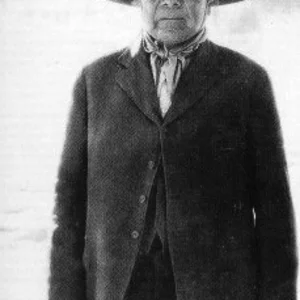
In photographs, Wovoka often appears wearing a large black felt hat, a sign of his life straddling Paiute culture and the dress of Nevada ranchers.
School Curriculum
Vocabulary & Tags
Key Vocabulary
Tags
Daily Life
Morning
Wovoka often began his day as a day laborer on the ranches of Mason Valley: tending cattle, mending fences, and working the fields for the white farmers in the area. This life of a seasonal worker was the daily reality for many Paiutes who had been dispossessed of their lands.
Afternoon
In the afternoon, he might receive visitors who had come from distant tribes, listen to their questions, and share his message of peace and dance. His reputation as a prophet drew ever-larger delegations after 1889.
Evening
In the evening, around the fire, came the songs and the stories; during the great ceremonies, the community formed the circle of the Ghost Dance, which could go on for several nights until exhaustion and trance set in.
Food
The Paiute diet of Nevada relied on pine nuts (the seeds of the piñon pine), game, fish from the lakes and rivers, and wild roots and seeds. With the reservations and wage labor came flour, coffee, and rations handed out by the Indian agency.
Clothing
Wovoka wore Western-style work clothes — a shirt, trousers, a jacket, and his broad felt hat — typical of Nevada ranchers, while keeping traditional elements for ceremonies, such as eagle feathers and ritual paint.
Housing
He lived in a modest dwelling on the reservation, blending the traditional conical Paiute hut (a wickiup, made of brush and reeds) with the rough wooden cabins that families built near the ranches and agencies.
Historical Timeline
Period Vocabulary
Liens externes & ressources
Références
Œuvres
Fondation de la Ghost Dance (Danse des Esprits)
1889
La « Lettre du Messie »
1890
Le rituel de la danse de cinq jours
1889
Les chants de la Danse des Esprits
1889-1890
Synthèse spirituelle paiute et chrétienne
1889