 flip
flipHoney-Glazed Roasted Wild Boar Haunch with Forest Herbs
Honey-Glazed Roasted Wild Boar Haunch with Forest Herbs
Why this dish? Charles Martel was above all a man of the hunt and war: the wild boar, noble game of the Austrasian forests around Herstal, is the meat of great feasts where the mayor of the palace gathered his faithful warriors before campaigns.
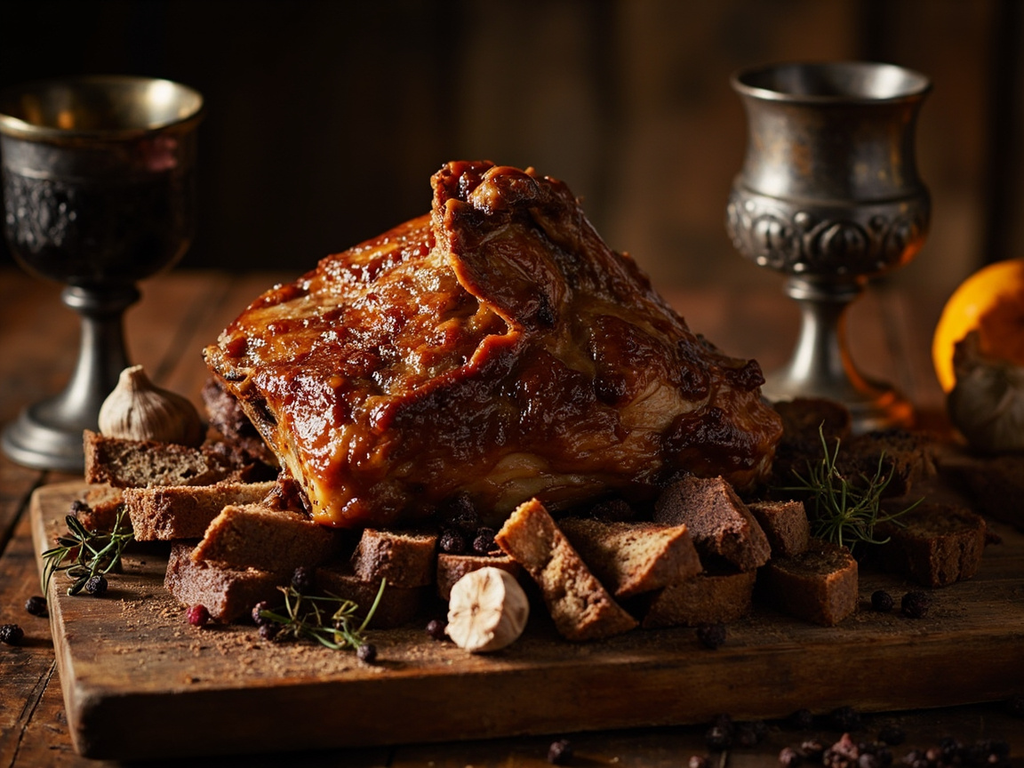
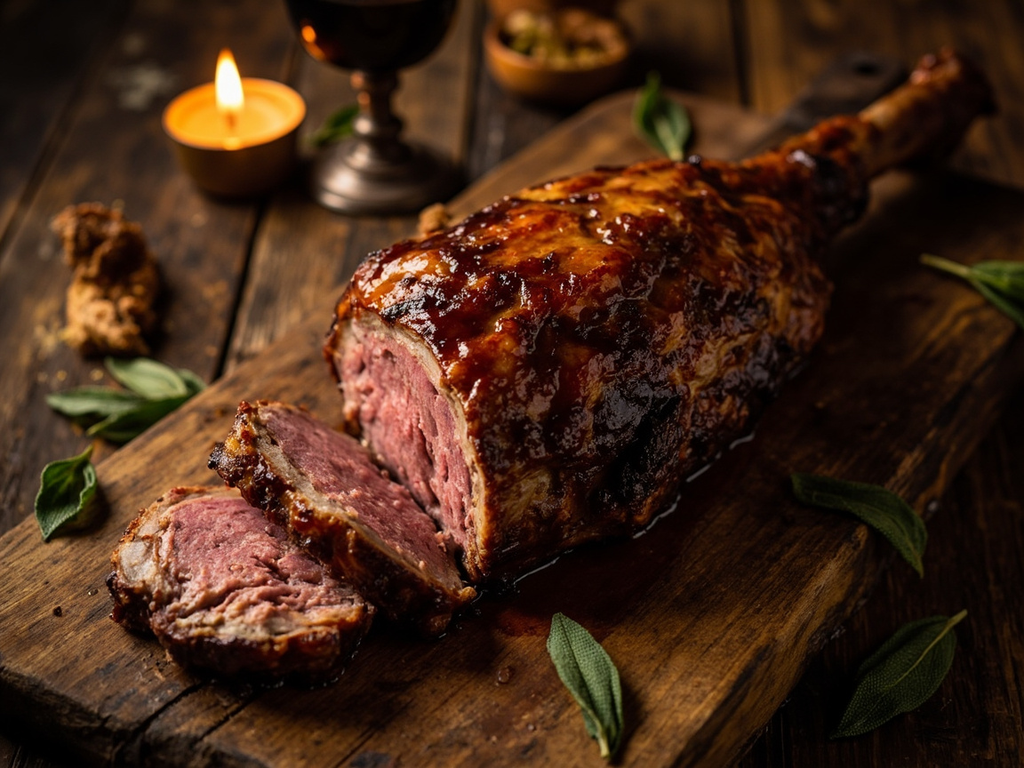
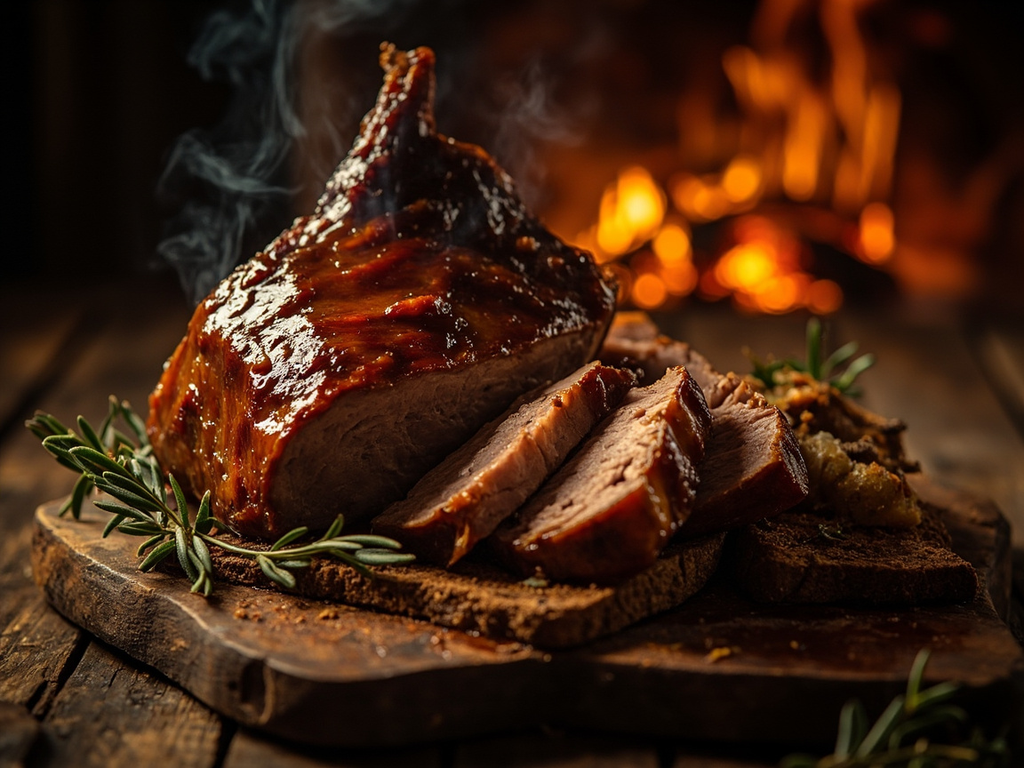
A quarter of wild boar long roasted on a spit, basted with honey and wine, perfumed with herbs gathered at the forest edge. The skin caramelizes while the flesh remains juicy: the dish that proclaims the power of a lord capable of hunting and feeding his entire host.
Approach, and fear not the smoke of the hearth. This beast I myself drove through the woods of Herstal, with the spear, as one drives the enemy at Poitiers. My servants have turned it all morning above the embers, and I had it anointed with honey and wine until the hide shone like an oiled tunic. Eat, warrior: a well-fed man holds his shield better, and he who shares my meat shares my cause.
- •Wild boar haunch — one quarter (game meat, centerpiece)
- •Forest honey — by the ladle (glaze and sweetness)
- •Wine — a good goblet (basting and deglazing)
- •Sage, lovage, savory — a handful (local herb fragrance)
- •Salt — a generous pinch (precious seasoning)
- •Pork fat — as needed (prevents drying)
Honey-Glazed Roasted Wild Boar Haunch with Forest Herbs
A quarter of wild boar long roasted on a spit, basted with honey and wine, perfumed with herbs gathered at the forest edge. The skin caramelizes while the flesh remains juicy: the dish that proclaims the power of a lord capable of hunting and feeding his entire host.
Why this dish? Charles Martel was above all a man of the hunt and war: the wild boar, noble game of the Austrasian forests around Herstal, is the meat of great feasts where the mayor of the palace gathered his faithful warriors before campaigns.
Approach, and fear not the smoke of the hearth. This beast I myself drove through the woods of Herstal, with the spear, as one drives the enemy at Poitiers. My servants have turned it all morning above the embers, and I had it anointed with honey and wine until the hide shone like an oiled tunic. Eat, warrior: a well-fed man holds his shield better, and he who shares my meat shares my cause.
Ingredients (period version)
- Wild boar haunch — one quarter (game meat, centerpiece)
- Forest honey — by the ladle (glaze and sweetness)
- Wine — a good goblet (basting and deglazing)
- Sage, lovage, savory — a handful (local herb fragrance)
- Salt — a generous pinch (precious seasoning)
- Pork fat — as needed (prevents drying)
Ingredients
- Shoulder or haunch of wild boar (or farm pork) — 1.5 kg (main meat)
- Liquid honey — 4 tbsp (glaze)
- Full-bodied red wine — 20 cl (marinade and basting)
- Fresh sage — 6 leaves (fragrance)
- Savory + lovage (or celery) — 1 tbsp (herbs)
- Garlic cloves — 3 (flavor (already known to Franks))
- Lard — 2 tbsp (greasing)
- Coarse salt — 2 tsp (seasoning)
Method
- The day before, rub the meat with salt, crushed garlic and herbs, sprinkle with wine and marinate in the fridge.
- Preheat oven to 150 °C. Pat the meat dry, brush with melted lard.
- Roast covered for 2.5 to 3 hours, basting every 30 minutes with the juices and marinade.
- Mix the honey with 2 tbsp of hot cooking juices.
- Uncover, brush with honey glaze, increase oven to 200 °C and let caramelize for 20 to 30 minutes, reapplying honey twice.
- Let rest 15 minutes, then slice thickly and serve on large country bread as a trencher.
How it was made : In Merovingian and Carolingian times, game was roasted whole or in quarters on a spit over the open hearth of the great hall. Honey, the only available sweetener, was used to glaze meats; pepper, imported at great cost, appeared only on the tables of the most powerful. Hunting was a privilege and military training of the Frankish aristocracy.
The contemporary twist : Plated on a wide raw wooden board with its juice-soaked bread trencher, warrior-banquet style — carved before the guests.
Charles Martel · Charactorium