 flip
flipSuzuke — salted pickled garden vegetables
Suzuke — salted pickled garden vegetables
Why this dish? Far from victory banquets, the ordinary table of the Yamato court relied on rice accompanied by salted and fermented vegetables, which kept all year. This is the everyday dish, the one that nourished the empress's entourage between ceremonies.
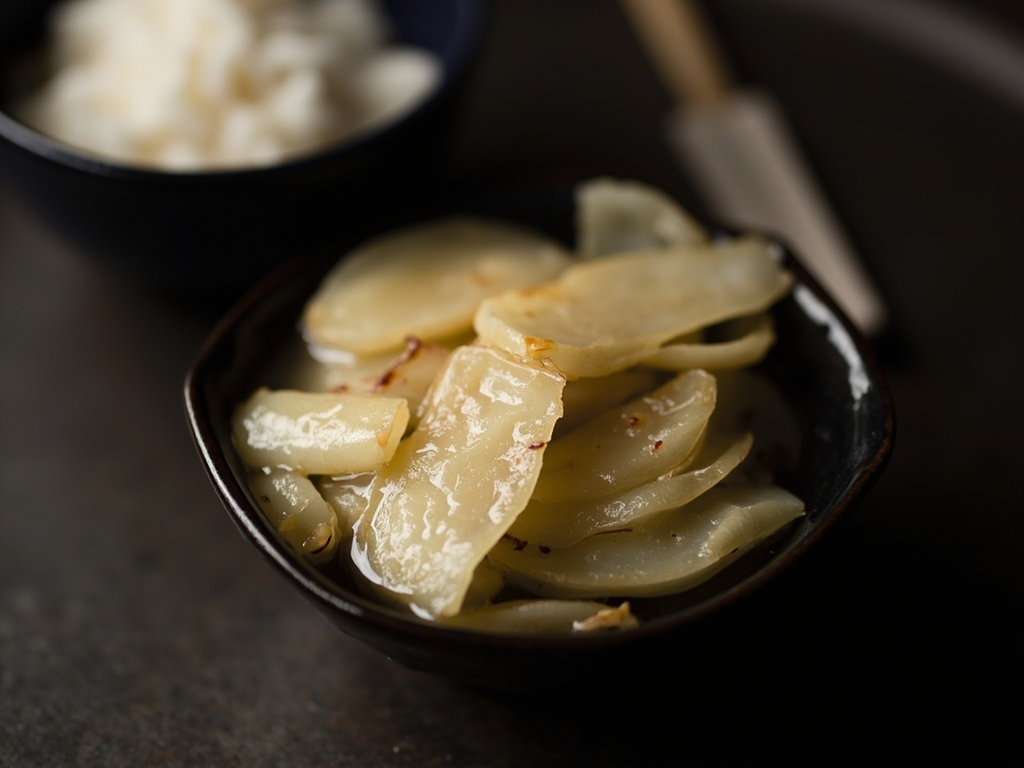
Root vegetables and leaves pressed in salt until they release their water and gently sour. Crunchy, salty, slightly tangy, they enliven a bowl of rice and bring the living sharpness of fermentation. The direct ancestor of Japanese tsukemono.
Not every day is a day of sea bream and drums, believe me. Between two rites, the table wants rice and these vegetables, tamed by salt. Take turnip and leaves from the garden, press them in salt under a heavy stone—yes, a stone, like the one I carried on the sea—and let time do its work. After a few days, they bite the tongue with a sour edge: that is a sign that the invisible gods of fermentation have labored. Serve them with rice, and the humble meal becomes sufficient.
- •Turnip, mustard greens, or radish (daikon) — as harvested (vegetables to ferment)
- •Sea salt — about 3% of vegetable weight (brine and preservation)
Suzuke — salted pickled garden vegetables
Root vegetables and leaves pressed in salt until they release their water and gently sour. Crunchy, salty, slightly tangy, they enliven a bowl of rice and bring the living sharpness of fermentation. The direct ancestor of Japanese tsukemono.
Why this dish? Far from victory banquets, the ordinary table of the Yamato court relied on rice accompanied by salted and fermented vegetables, which kept all year. This is the everyday dish, the one that nourished the empress's entourage between ceremonies.
Not every day is a day of sea bream and drums, believe me. Between two rites, the table wants rice and these vegetables, tamed by salt. Take turnip and leaves from the garden, press them in salt under a heavy stone—yes, a stone, like the one I carried on the sea—and let time do its work. After a few days, they bite the tongue with a sour edge: that is a sign that the invisible gods of fermentation have labored. Serve them with rice, and the humble meal becomes sufficient.
Ingredients (period version)
- Turnip, mustard greens, or radish (daikon) — as harvested (vegetables to ferment)
- Sea salt — about 3% of vegetable weight (brine and preservation)
Ingredients
- Turnips and/or daikon — 400 g (base)
- Green leaves (cabbage, tops) — 100 g (variety)
- Sea salt — 15 g (~3%) (brine)
Method
- Wash and thinly slice the vegetables.
- Massage them with salt in a bowl until they begin to release water.
- Pack into a clean container, place a plate and a weight on top (a water-filled jar, a clean stone).
- Leave at room temperature for 2 to 4 days (the vegetables should be submerged in their brine), then taste: when the acidity pleases you, refrigerate. Rinse lightly before serving if too salty.
How it was made : Before rice bran (nuka) and miso, vegetables were preserved by simple dry salt pressing: suzuke. Spontaneous lactic fermentation gave them acidity and longevity, making them the permanent accompaniment to rice throughout ancient Japan.
The contemporary twist : Cut into thin fans and arranged in a checkerboard pattern next to the rice: a neat presentation that turns the humble pickle into a small picture.
Empress Jingu · Charactorium