 flip
flipSmørrebrød with Marinated Herring on Rye Bread
Smørrebrød with Marinated Herring on Rye Bread
Why this dish? Son of a poor shoemaker from Odense, Andersen grew up with herring and rye bread as staples; when famous, he found this smørrebrød on Danish tables, from the humblest home to the cold buffet of Copenhagen.
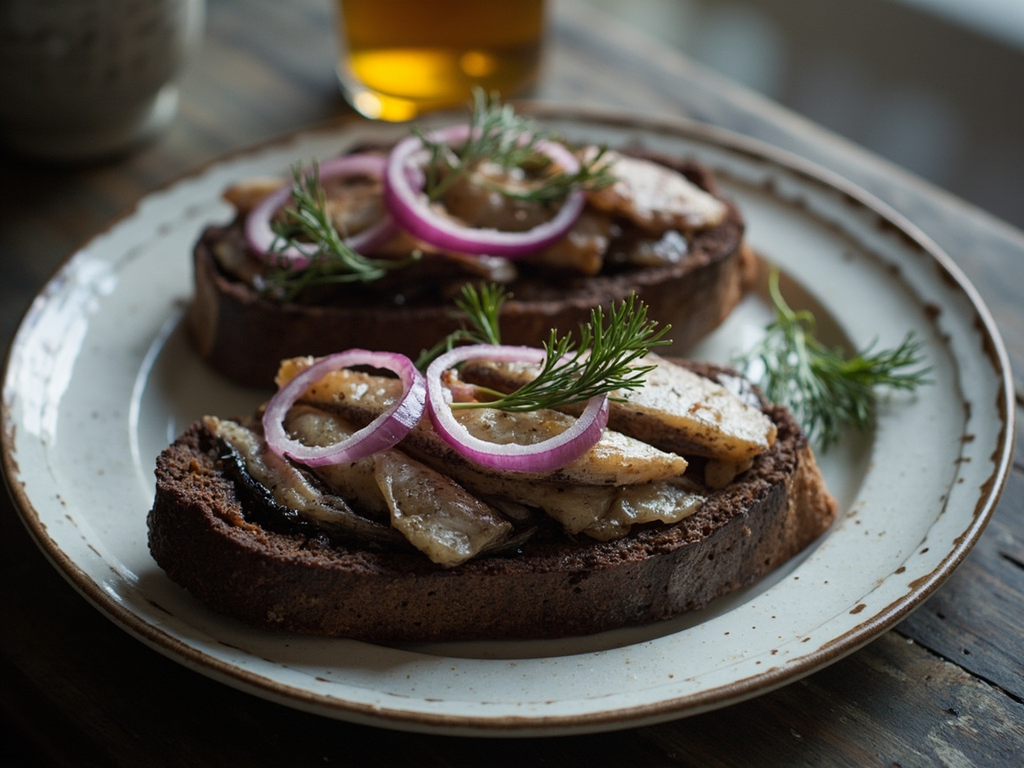
A thick slice of dense rye bread, buttered, topped with marinated herring fillets, onion rings, and a sprig of dill. The open-faced smørrebrød is eaten with fork and knife, never as a closed sandwich.
You see, I was born in the house of a shoemaker in Odense, and herring on black bread was the first feast I ever knew. My mother would lay the glistening fillet on the buttered rye, add the onion in rings, and we ate without cloth or ceremony. Later, at the fine tables of Copenhagen, I found the same herring again, and I smiled: the simplest tale is often the truest. Taste it slowly, and think that a poor child can dream as high as the stork on the roof.
- •Sourdough rye bread (rugbrød) — thick slices (base)
- •Salted herring, desalted and marinated in vinegar — as needed (main topping)
- •Churned butter — a knob per slice (binding and richness)
- •Onion — in thin rings (bite)
- •Dill — a few sprigs (aroma)
Smørrebrød with Marinated Herring on Rye Bread
A thick slice of dense rye bread, buttered, topped with marinated herring fillets, onion rings, and a sprig of dill. The open-faced smørrebrød is eaten with fork and knife, never as a closed sandwich.
Why this dish? Son of a poor shoemaker from Odense, Andersen grew up with herring and rye bread as staples; when famous, he found this smørrebrød on Danish tables, from the humblest home to the cold buffet of Copenhagen.
You see, I was born in the house of a shoemaker in Odense, and herring on black bread was the first feast I ever knew. My mother would lay the glistening fillet on the buttered rye, add the onion in rings, and we ate without cloth or ceremony. Later, at the fine tables of Copenhagen, I found the same herring again, and I smiled: the simplest tale is often the truest. Taste it slowly, and think that a poor child can dream as high as the stork on the roof.
Ingredients (period version)
- Sourdough rye bread (rugbrød) — thick slices (base)
- Salted herring, desalted and marinated in vinegar — as needed (main topping)
- Churned butter — a knob per slice (binding and richness)
- Onion — in thin rings (bite)
- Dill — a few sprigs (aroma)
Ingredients
- Dense rye bread — 4 slices (base)
- Marinated herring fillets (rollmops or maatjes) — 8 fillets (main topping)
- Salted butter — 40 g (binding)
- Red onion — 1 small (bite)
- Fresh dill — 1 small bunch (aroma)
Method
- Generously butter each slice of rye bread to the edges.
- Drain the herring fillets and arrange them on the butter, folded or in strips.
- Slice the onion into very thin rings and scatter over the herring.
- Add a few sprigs of chopped dill and a twist of pepper.
- Serve fresh, with fork and knife, without closing the bread.
How it was made : Barrel-salted herring was the most accessible protein in Denmark: it was desalted then marinated in vinegar and spices to mellow it. Sourdough rye bread, baked in dense loaves that kept for a long time, formed the base of all spread meals.
The contemporary twist : A touch of sour cream and lumpfish roe transforms the humble childhood snack into a festive bite, without betraying the spirit.
Hans Christian Andersen · Charactorium