 flip
flipHarisa-ye lashkari (wheat and lamb porridge of the campaigns)
Harisa-ye lashkari (wheat and lamb porridge of the campaigns)
Why this dish? Ismail Samani led many military campaigns to unify Transoxiana. Harisa — a porridge of cracked wheat and long-simmered meat — is the quintessential marching dish, nourishing and easy to prepare in large quantities for troops on the move. This dish is attested in Abbasid sources as soldiers' and travelers' food.
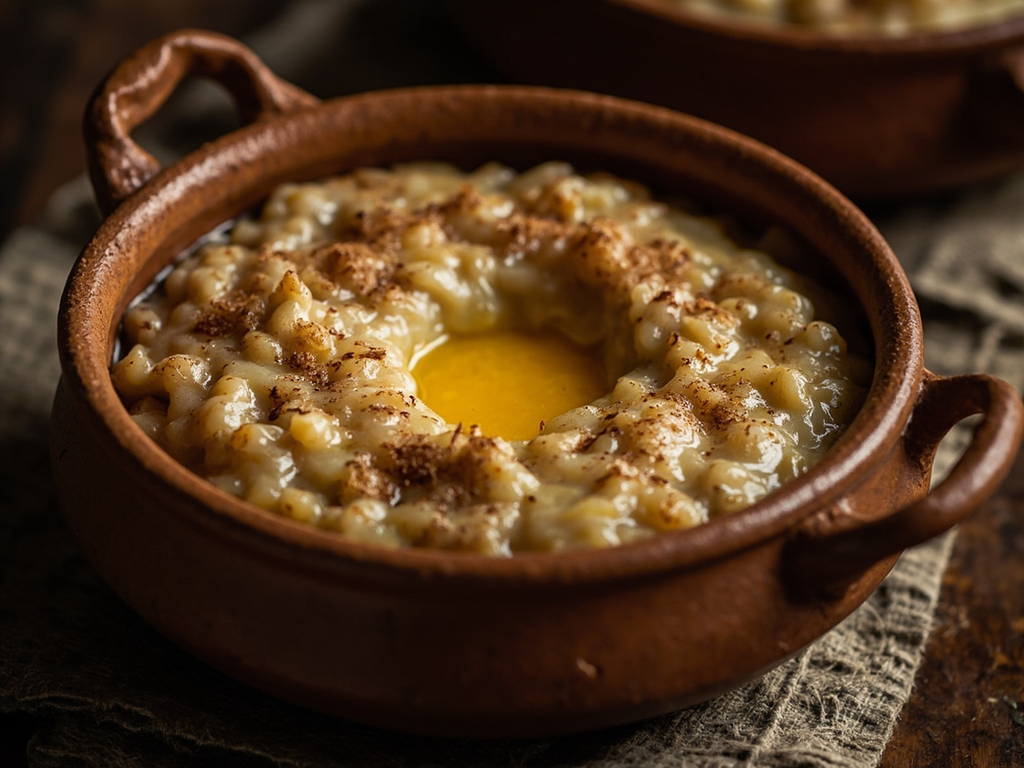
Thick porridge made by slowly cooking cracked wheat with lamb until the meat shreds into the creamy mass. Seasoned with cinnamon and clarified butter, it is a dish of rustic simplicity but deep comfort, served piping hot in earthenware bowls.
When the army marches toward Balkh or Samarkand, there is no question of pilaf or refinements. My men need strength, and harisa gives it to them. We put the wheat and mutton in the cauldron before dawn, and we stir, and stir again, until the meat disappears into the grain. A man who has eaten his harisa can ride all day without flagging. I have melted butter poured over it and a cloud of cinnamon — even on campaign, an emir does not eat without grace.
- •Cracked wheat (djarish) — Two good handfuls (Grain base)
- •Lamb shoulder or neck — A piece with the bone (Protein and flavor)
- •Clarified butter (roghan) — A good piece (Richness and finish)
- •Cinnamon stick — One piece (Warm fragrance)
- •Salt — To taste (Seasoning)
- •Water — Plenty (Long cooking)
Harisa-ye lashkari (wheat and lamb porridge of the campaigns)
Thick porridge made by slowly cooking cracked wheat with lamb until the meat shreds into the creamy mass. Seasoned with cinnamon and clarified butter, it is a dish of rustic simplicity but deep comfort, served piping hot in earthenware bowls.
Why this dish? Ismail Samani led many military campaigns to unify Transoxiana. Harisa — a porridge of cracked wheat and long-simmered meat — is the quintessential marching dish, nourishing and easy to prepare in large quantities for troops on the move. This dish is attested in Abbasid sources as soldiers' and travelers' food.
When the army marches toward Balkh or Samarkand, there is no question of pilaf or refinements. My men need strength, and harisa gives it to them. We put the wheat and mutton in the cauldron before dawn, and we stir, and stir again, until the meat disappears into the grain. A man who has eaten his harisa can ride all day without flagging. I have melted butter poured over it and a cloud of cinnamon — even on campaign, an emir does not eat without grace.
Ingredients (period version)
- Cracked wheat (djarish) — Two good handfuls (Grain base)
- Lamb shoulder or neck — A piece with the bone (Protein and flavor)
- Clarified butter (roghan) — A good piece (Richness and finish)
- Cinnamon stick — One piece (Warm fragrance)
- Salt — To taste (Seasoning)
- Water — Plenty (Long cooking)
Ingredients
- Cracked wheat (coarse bulgur or pearl wheat) — 250 g (Grain base)
- Boneless lamb shoulder — 400 g (Protein and flavor)
- Ghee or clarified butter — 3 tbsp (Richness and finish)
- Cinnamon stick — 1 (Warm fragrance)
- Salt — 1 tsp (Seasoning)
- Water — 1.5 liters (Long cooking)
Method
- Rinse cracked wheat and soak in cold water for 2 hours. Drain.
- Place lamb pieces in a large pot with 1.5 liters cold water and the cinnamon stick. Bring to a boil, skimming carefully.
- Add drained wheat and salt. Reduce to low heat, cover, and cook for 2 hours, stirring regularly with a wooden spoon to prevent sticking.
- When the meat shreds into fibers and the wheat forms a thick, homogeneous mass, remove the cinnamon stick. Mash remaining pieces with a spoon.
- Serve piping hot in bowls. Make a well in the center, pour in a generous spoonful of melted ghee, and sprinkle with ground cinnamon.
How it was made : Harisa is one of the most anciently documented dishes in medieval Islamic cuisine. Al-Warraq's Kitab al-Tabikh (10th century) gives several versions. Al-Mas'udi mentions it was served to troops and travelers in caravanserais. Cracked wheat (djarish) was preferred to rice for its ability to thicken and satisfy.
The contemporary twist : Serve in a stoneware bowl, draw a spiral pattern with melted ghee, and garnish with a few shavings of freshly grated cinnamon.
Sources : Nawal Nasrallah, Annals of the Caliphs' Kitchens: Ibn Sayyār al-Warrāq's Tenth-Century Baghdadi Cookbook, Brill, 2007 · Al-Mas'udi, Muruj adh-Dhahab (The Meadows of Gold), trans. Barbier de Meynard, 9th century
Ismail Samani · Charactorium