 flip
flipPalaw-e zarrin (golden saffron lamb pilaf)
Palaw-e zarrin (golden saffron lamb pilaf)
Why this dish? Pilaf is the emblematic dish of Bukhara, capital of Ismail Samani. Chronicles describe banquets where saffron rice accompanied the emir's military victories. This palaw evokes the court feasts after the decisive conquest of Transoxiana in 900.
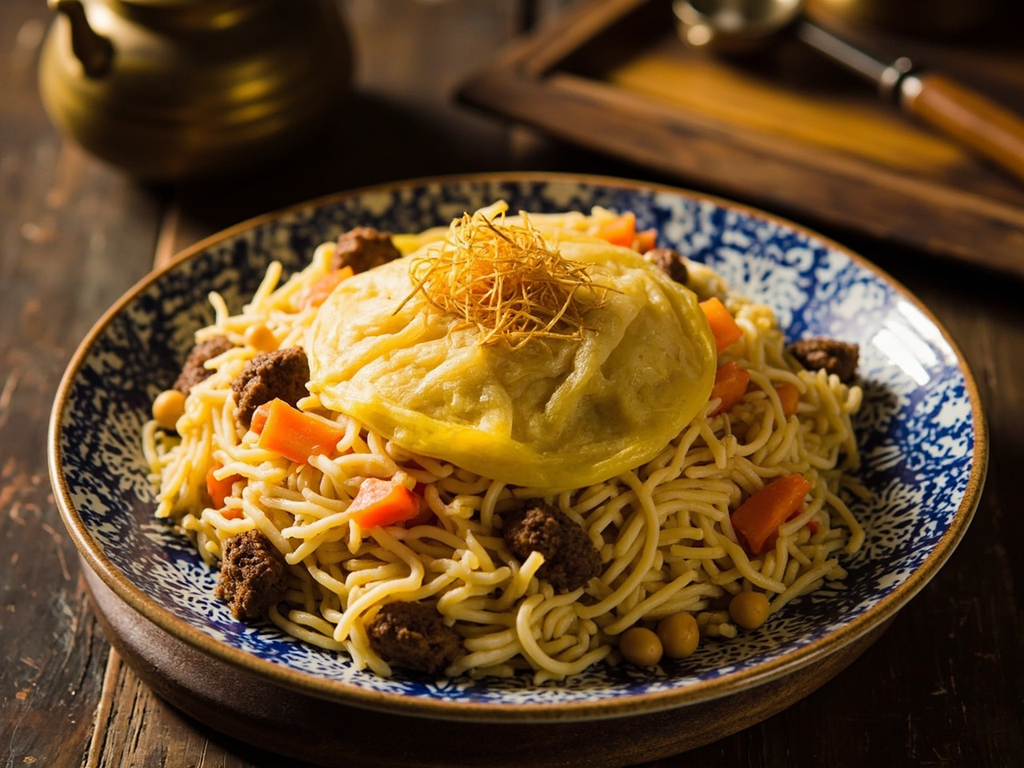
Long-grain rice cooked with tender lamb, carrots, chickpeas, and saffron. Central Asian palaw is distinguished by its layered cooking (dampokhtak): the meat and vegetables first simmer at the bottom of the cauldron, then the rice covers them and cooks in the fragrant steam. Saffron and cumin give it a golden color and deep aroma.
Know, you who read these lines, that no feast in Bukhara can be held without palaw. When my horsemen returned from Balkh, I ordered the saffron stores opened and every pot wide enough to feed ten men. The rice must swell in the steam of the meat, not in water — that way each grain carries the memory of the mutton. My cook lays the carrots in a cross over the rice, as a sign of blessing, and none touches the dish until the scent of za'farân has filled the entire hall.
- •Long-grain rice from Transoxiana — Three generous handfuls (Base of the pilaf)
- •Lamb shoulder — A good piece with the bone (Tender meat)
- •Yellow carrots — Several, cut into sticks (Sweetness and color)
- •Dried chickpeas — A handful, soaked overnight (Body and nutrition)
- •Saffron — A pinch infused in hot water (Fragrance and golden color)
- •Cumin seeds — Half a spoonful (Earthy aroma)
- •Onion — One large, sliced (Flavor base)
- •Sheep tail fat — A good piece (Cooking fat)
- •Salt — To taste (Seasoning)
Palaw-e zarrin (golden saffron lamb pilaf)
Long-grain rice cooked with tender lamb, carrots, chickpeas, and saffron. Central Asian palaw is distinguished by its layered cooking (dampokhtak): the meat and vegetables first simmer at the bottom of the cauldron, then the rice covers them and cooks in the fragrant steam. Saffron and cumin give it a golden color and deep aroma.
Why this dish? Pilaf is the emblematic dish of Bukhara, capital of Ismail Samani. Chronicles describe banquets where saffron rice accompanied the emir's military victories. This palaw evokes the court feasts after the decisive conquest of Transoxiana in 900.
Know, you who read these lines, that no feast in Bukhara can be held without palaw. When my horsemen returned from Balkh, I ordered the saffron stores opened and every pot wide enough to feed ten men. The rice must swell in the steam of the meat, not in water — that way each grain carries the memory of the mutton. My cook lays the carrots in a cross over the rice, as a sign of blessing, and none touches the dish until the scent of za'farân has filled the entire hall.
Ingredients (period version)
- Long-grain rice from Transoxiana — Three generous handfuls (Base of the pilaf)
- Lamb shoulder — A good piece with the bone (Tender meat)
- Yellow carrots — Several, cut into sticks (Sweetness and color)
- Dried chickpeas — A handful, soaked overnight (Body and nutrition)
- Saffron — A pinch infused in hot water (Fragrance and golden color)
- Cumin seeds — Half a spoonful (Earthy aroma)
- Onion — One large, sliced (Flavor base)
- Sheep tail fat — A good piece (Cooking fat)
- Salt — To taste (Seasoning)
Ingredients
- Basmati rice — 400 g (Base of the pilaf)
- Lamb shoulder — 500 g, cubed (Tender meat)
- Carrots — 3 medium, cut into sticks (Sweetness and color)
- Chickpeas — 100 g (dried, soaked 12 h) or 200 g canned (Body and nutrition)
- Saffron threads — 1 good pinch (0.2 g) (Fragrance and golden color)
- Cumin seeds — 1 tsp (Earthy aroma)
- Yellow onion — 1 large (Flavor base)
- Vegetable oil or ghee — 4 tbsp (Cooking fat)
- Salt — 1.5 tsp (Seasoning)
- Hot water — 60 ml (to infuse saffron) (Saffron infusion)
Method
- Rinse basmati rice in cold water until clear, then soak for 30 minutes. Infuse saffron in 60 ml hot water.
- In a heavy-bottomed pot, heat oil or ghee over high heat. Brown lamb pieces on all sides (5-7 min), then set aside.
- In the same fat, sauté sliced onion until golden. Add cumin and stir for 30 seconds.
- Return lamb, add carrot sticks and drained chickpeas. Cover with water, salt, bring to a boil, then simmer covered for 40 minutes.
- Drain rice and gently spread it in an even layer over meat and vegetables without mixing. Pour hot water to 1 cm above the rice.
- Drizzle saffron infusion over the rice. Cover tightly (a towel under the lid helps trap steam). Cook on very low heat for 25-30 minutes without opening.
- Turn off heat and let rest covered for 10 minutes. Invert the pilaf onto a large serving platter, arranging meat and carrots over the golden rice.
How it was made : Pilaf (palaw) is attested in Central Asia long before the Samanids. Abbasid culinary treatises from the 9th-10th century describe aruzz mufalfal (rice with separate grains) cooked with meat. Sheep tail fat (alya) served as the main cooking fat. Yellow carrots, native to the region, are a constant in traditional Uzbek pilaf.
The contemporary twist : Serve each portion in a small bowl inverted on the plate as a golden dome, garnished with a few saffron threads and chopped pistachios.
Sources : Nawal Nasrallah, Annals of the Caliphs' Kitchens: Ibn Sayyār al-Warrāq's Tenth-Century Baghdadi Cookbook, Brill, 2007 · Charles Perry, "The Central Asian Pilaf", in A Baghdad Cookery Book (trans.), Prospect Books, 2005
Ismail Samani · Charactorium