 flip
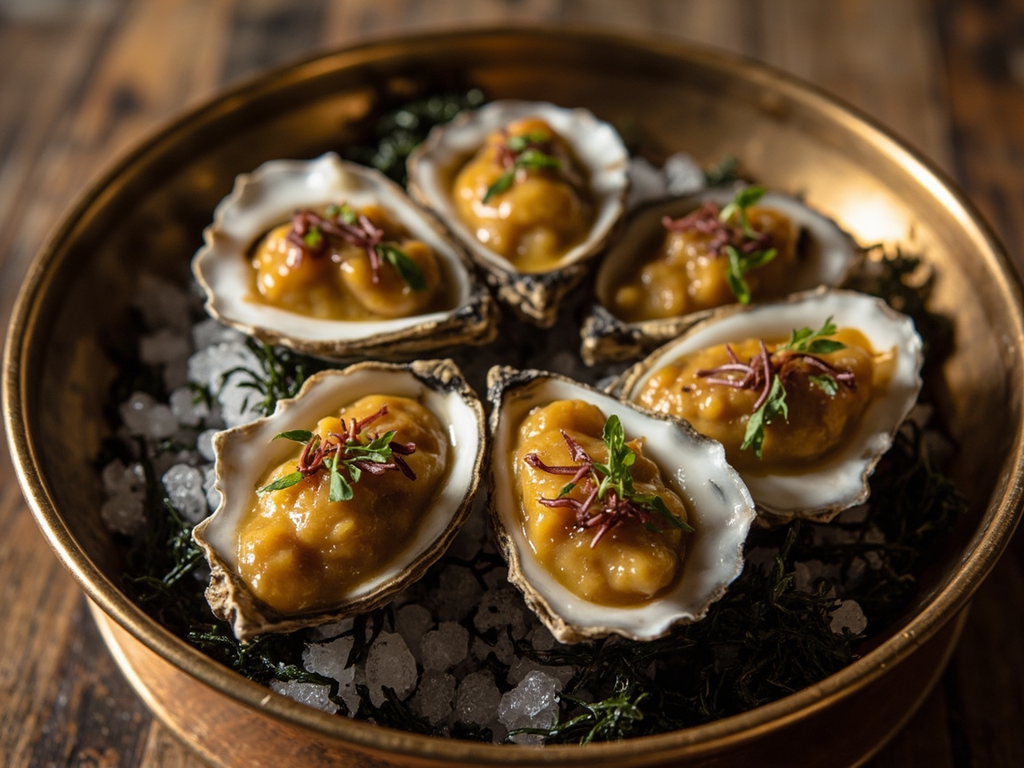
flipOysters with Garum, Honey, and Lovage (Ostrea cum garo)
Oysters with Garum, Honey, and Lovage (Ostrea cum garo)
Why this dish? Nero was fond of shellfish from the edges of the empire: oysters were shipped to Rome from Brittany (modern-day Great Britain) and Spain. Serving oysters from the ends of the earth displayed imperial power from the very first bite.
Fresh oysters dressed with a classic Roman sauce: garum, vinegar, honey, pepper, and lovage. The salty-fermented garum amplifies the oyster's iodine, while honey and vinegar provide the sweet-sour balance the Romans adored.
Approach, and see what Caesar offers at his table! These oysters, my fleets have torn them from the mists of Britain and the coasts of Hispania: no mouth but an emperor's has tasted shellfish from so far. My cooks drizzle them with a dash of garum, a tear of honey, and a hint of Eastern pepper—for a prince does not eat as one feeds, he composes, just as I compose on the cithara. Taste, and tell me if all of Rome does not reside in this single shell.
- •Live oysters — twelve, the plumpest (iodine base)
- •Garum (liquamen) — a few drops (fermented salt, umami)
- •Honey — a spoonful (sweetness)
- •Wine vinegar — a dash (acidity)
- •Long pepper from the East — freshly ground (spice)
- •Lovage — a few leaves (aromatic herb)
- •Egg yolk — one (sauce binder)
Oysters with Garum, Honey, and Lovage (Ostrea cum garo)
Fresh oysters dressed with a classic Roman sauce: garum, vinegar, honey, pepper, and lovage. The salty-fermented garum amplifies the oyster's iodine, while honey and vinegar provide the sweet-sour balance the Romans adored.
Why this dish? Nero was fond of shellfish from the edges of the empire: oysters were shipped to Rome from Brittany (modern-day Great Britain) and Spain. Serving oysters from the ends of the earth displayed imperial power from the very first bite.
Approach, and see what Caesar offers at his table! These oysters, my fleets have torn them from the mists of Britain and the coasts of Hispania: no mouth but an emperor's has tasted shellfish from so far. My cooks drizzle them with a dash of garum, a tear of honey, and a hint of Eastern pepper—for a prince does not eat as one feeds, he composes, just as I compose on the cithara. Taste, and tell me if all of Rome does not reside in this single shell.
Ingredients (period version)
- Live oysters — twelve, the plumpest (iodine base)
- Garum (liquamen) — a few drops (fermented salt, umami)
- Honey — a spoonful (sweetness)
- Wine vinegar — a dash (acidity)
- Long pepper from the East — freshly ground (spice)
- Lovage — a few leaves (aromatic herb)
- Egg yolk — one (sauce binder)
Ingredients
- Fresh oysters — 12 (iodine base)
- Nuoc mam or artisanal garum — 1 tsp (garum substitute (salty umami))
- Liquid honey — 1 tsp (sweetness)
- White wine vinegar — 1 tsp (acidity)
- Black pepper from the mill — 2 turns (spice)
- Lovage (or celery stalk if unavailable) — 4 finely chopped leaves (aromatic herb)
- Egg yolk — 1 (binder)
Method
- Carefully open the oysters, discard the first water, keep them chilled on a bed of ice.
- In a bowl, whisk the egg yolk with honey and vinegar.
- Add the garum (or nuoc mam), pepper, and chopped lovage; mix into a coating sauce.
- Place half a spoonful of sauce on each oyster just before serving.
- Serve immediately, very cold, as the opening course.
How it was made : Apicius gives several sauces *in ostreis* mixing garum, vinegar, honey, pepper, lovage, and egg yolk. The Romans transported live oysters in vivaria and baskets of damp seaweed; Sergius Orata even invented heated oyster ponds near Naples.
The contemporary twist : Serve on a bed of coarse salt and dried seaweed, with the Latin name *Ostrea* calligraphed on a slate—a nod to imperial luxury in an oyster bar style.
Sources : Apicius, De re coquinaria, Book IX (Thalassa / shellfish) · Pliny the Elder, Natural History, IX (on oysters and Roman vivaria)
Nero · Charactorium