 flip
flipHalvâ-ye ard (saffron and pistachio flour halva)
Halvâ-ye ard (saffron and pistachio flour halva)
Why this dish? Flour halva, a rich and fragrant sweet, was the celebration dish par excellence in the Persian world — served at Nowruz, births, military victories, and poetry evenings. Rûdakî, who participated in countless banquets at the Bukhara court for over forty years, certainly knew this emblematic dish, golden with saffron, shared as a sign of joy and generosity.
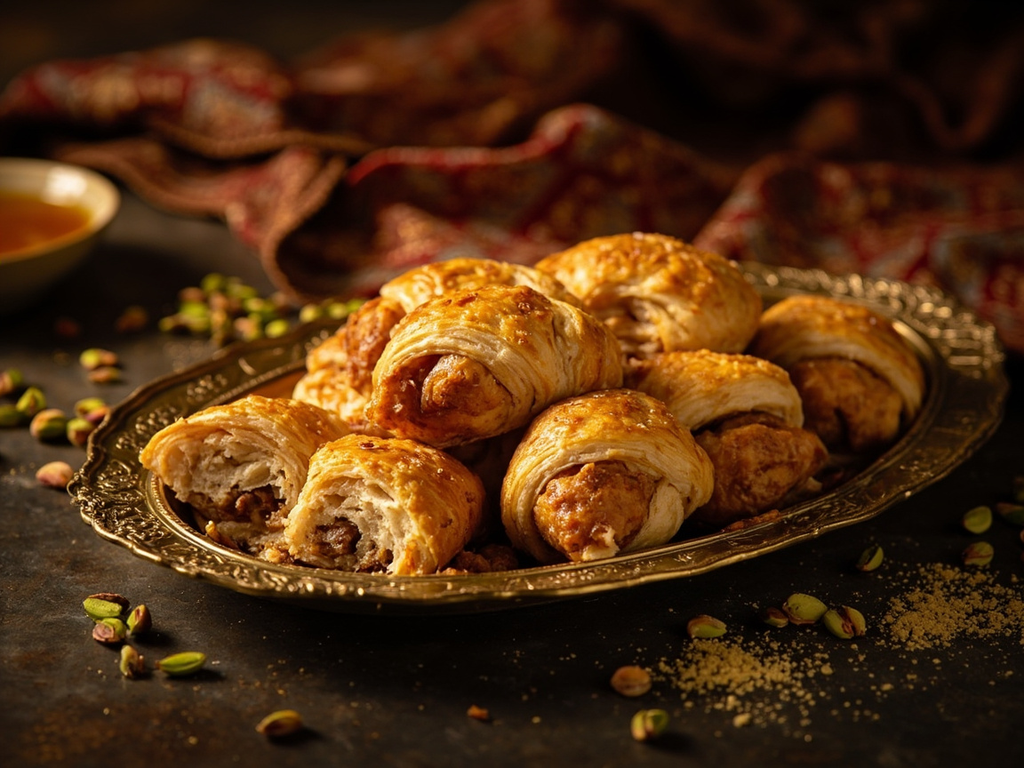
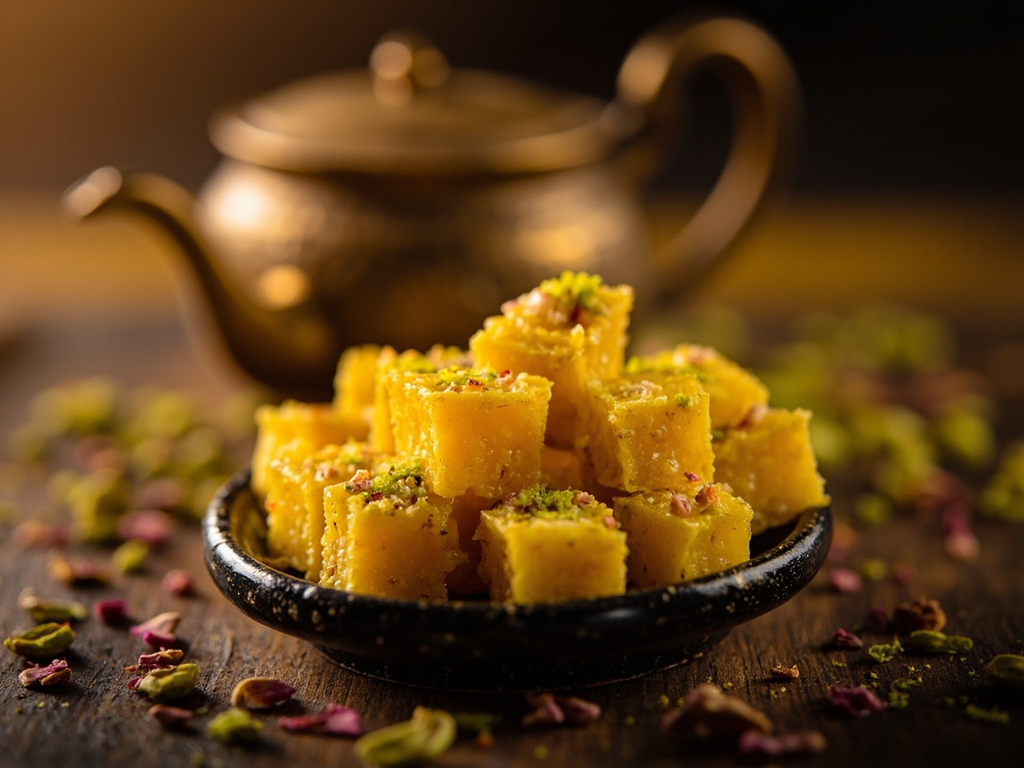
A dense, melt-in-the-mouth halva, made by toasting flour in clarified butter until golden, then soaking it in a syrup perfumed with saffron and rose water. Sprinkled with crushed pistachios and cardamom.
Halva, friend, is the sweetness offered when the heart overflows — at Nowruz, when the world is reborn, or when the emir celebrates a victory. The cooks of Bukhara stir the flour in butter over a patient fire, without haste, as a poet turns a verse over in his mouth before delivering it. When the flour takes the color of amber, the saffron syrup is poured in, and the whole kitchen is fragrant. I have always thought that halva resembles poetry: simple in appearance, but it takes time, hand, and heart to succeed.
- •Fine wheat flour — one measure (Base)
- •Clarified butter — equal measure to flour (Toasting and richness)
- •Honey or sugar — half measure (Sweet syrup)
- •Water — one measure (Syrup)
- •Saffron — a pinch in the syrup (Color and aroma)
- •Rose water — a drizzle (Aroma)
- •Crushed pistachios — a handful (Decoration and crunch)
- •Ground cardamom — a hint (Spice)
Halvâ-ye ard (saffron and pistachio flour halva)
A dense, melt-in-the-mouth halva, made by toasting flour in clarified butter until golden, then soaking it in a syrup perfumed with saffron and rose water. Sprinkled with crushed pistachios and cardamom.
Why this dish? Flour halva, a rich and fragrant sweet, was the celebration dish par excellence in the Persian world — served at Nowruz, births, military victories, and poetry evenings. Rûdakî, who participated in countless banquets at the Bukhara court for over forty years, certainly knew this emblematic dish, golden with saffron, shared as a sign of joy and generosity.
Halva, friend, is the sweetness offered when the heart overflows — at Nowruz, when the world is reborn, or when the emir celebrates a victory. The cooks of Bukhara stir the flour in butter over a patient fire, without haste, as a poet turns a verse over in his mouth before delivering it. When the flour takes the color of amber, the saffron syrup is poured in, and the whole kitchen is fragrant. I have always thought that halva resembles poetry: simple in appearance, but it takes time, hand, and heart to succeed.
Ingredients (period version)
- Fine wheat flour — one measure (Base)
- Clarified butter — equal measure to flour (Toasting and richness)
- Honey or sugar — half measure (Sweet syrup)
- Water — one measure (Syrup)
- Saffron — a pinch in the syrup (Color and aroma)
- Rose water — a drizzle (Aroma)
- Crushed pistachios — a handful (Decoration and crunch)
- Ground cardamom — a hint (Spice)
Ingredients
- All-purpose flour — 200 g (Base)
- Clarified butter (ghee) — 200 g (Toasting and richness)
- Granulated sugar — 150 g (Syrup)
- Water — 250 ml (Syrup)
- Saffron threads — a pinch (0.2 g), infused in 2 tbsp hot water (Color and aroma)
- Rose water — 1 tbsp (Aroma)
- Unsalted pistachios, crushed — 30 g (Decoration and crunch)
- Ground cardamom — ¼ tsp (Spice)
Method
- Make the syrup: dissolve the sugar in water over medium heat, add the infused saffron and rose water. Bring to a simmer for 2 minutes. Keep warm.
- In a large heavy-bottomed pan, melt the ghee over medium-low heat. Add the flour all at once and stir constantly with a wooden spoon.
- Toast the flour in the ghee for 15–20 minutes, stirring continuously, until it takes a beautiful golden hazelnut color and smells like biscuit. Patience: this step makes everything.
- Remove from heat and pour in the hot syrup all at once, stirring vigorously (watch for splashes). Add the cardamom.
- Return to low heat and stir for 3–4 minutes until the mixture forms a thick mass that pulls away from the sides.
- Pour into an oiled mold or dish, smooth the surface, sprinkle with crushed pistachios, and press lightly.
- Let cool slightly, cut into diamonds, and serve at room temperature.
How it was made : Flour halva (halvâ-ye ard) is one of the oldest forms of halva, attested in medieval Persian and Arabic culinary texts. Al-Warraq gives several recipes. The word "halva" comes from Arabic ḥulw (sweet). The version with saffron and rose water is characteristic of Khorasan and Transoxiana, where these two ingredients were abundant.
The contemporary twist : Mold the halva in small diamond-shaped individual molds, unmold onto a black plate to highlight the saffron color, and decorate each with a dried rose petal.
Sources : Nawal Nasrallah, Annals of the Caliph's Kitchens: Ibn Sayyār al-Warrāq's Tenth-Century Baghdadi Cookbook (Brill, 2007) · Charles Perry, A Baghdad Cookery Book (Prospect Books, 2005)
Rudaki · Charactorium