Kids interview Baldr
by Charactorium · Baldr · Mythology · 5 min read
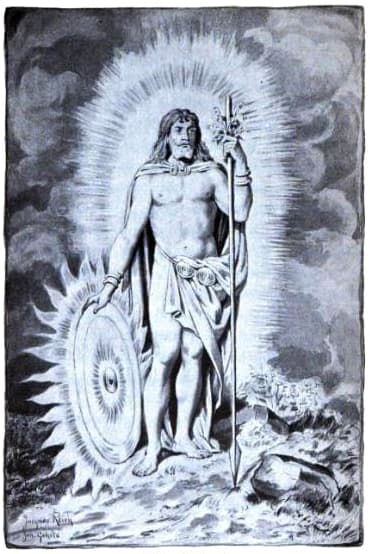
That morning, two twelve-year-old visitors leave their school trip for a place of light. Before them stands Baldr, the shining god, surrounded by a gentle radiance. He leans toward them and smiles, happy that people still come to listen to him.
—Hello! We were told that you shine. Is that true, for real?
Yes, my child, it's true. A light comes from me like a gentle ember. In the old book called the Edda, it is said of me that I am the best, and that a radiance shines from my person. I live in a hall named Breiðablik, high up among the gods. Imagine a house with silver walls and a gold roof, where nothing unclean, nothing deceitful can enter. It is like water so clear you can see the bottom. I wear white clothes embroidered with silver, and I dispense justice in the morning, with gentleness.
In my home, nothing unclean, nothing deceitful can enter.
—What did you do with your days, then? Weren't you bored up there?
Oh no, never! In the morning, I listen to the complaints of the gods and judge calmly. In the afternoon, I walk in the meadows of the sky, what we call Asgard, the land of the gods. In the evening, we feast all together. We drink mead — it's a beer made with honey — and we eat the sacred boar that regenerates every night. Imagine a large table where food never runs out. Around me, everything is peaceful. The other gods like me well, you know. They say that where I pass, anger subsides. I was a happy god.
—But we read that you had horrible nightmares. What were they?
You read well, my child. At night, heavy dreams came to visit me. Dark dreams that spoke of my death. In the evening, at the banquet, I would become silent, and that troubled the feast. A very old poem tells this: it is called Baldrs draumar, "The Dreams of Baldr." Imagine waking up every morning with a heavy heart, not knowing why. The gods were worried. A father cannot bear to see his son tormented. So my father Odin decided to go seek the truth, far away, among the dead.
Dark dreams came to visit me, and they spoke of my death.
—How did your dad Odin find out the truth?
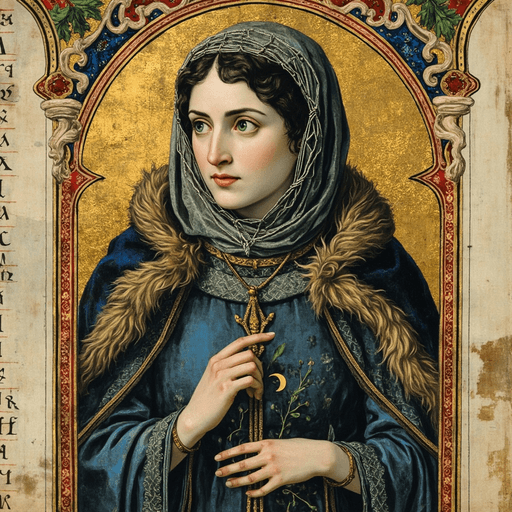
He did a grave thing, my child. He went down to the realm of the dead, and there he awakened a völva. A völva is a seeress, a woman who reads the future through a magic called seiðr. But this one was already dead! Odin forced her to speak from her grave. Imagine an old voice rising from the earth, reluctantly. She told him the sad truth: yes, Baldr would die. My father left heavy-hearted. He knew now. But knowing is not always enough to prevent fate.
—And your mom, didn't she do anything to protect you?
Oh yes, she did everything! My mother Frigg loved me so much. She traveled the whole world, can you imagine? She asked every thing to swear never to harm me. Fire, water, iron, stones, animals, trees… all promised. But she forgot one small plant: the mistletoe. She found it too young, too tender to make it swear. Such a small detail, my child! It's like leaving a single door open in a great castle. And through that door, misfortune would enter.
A single oversight, a single open door, and misfortune enters.
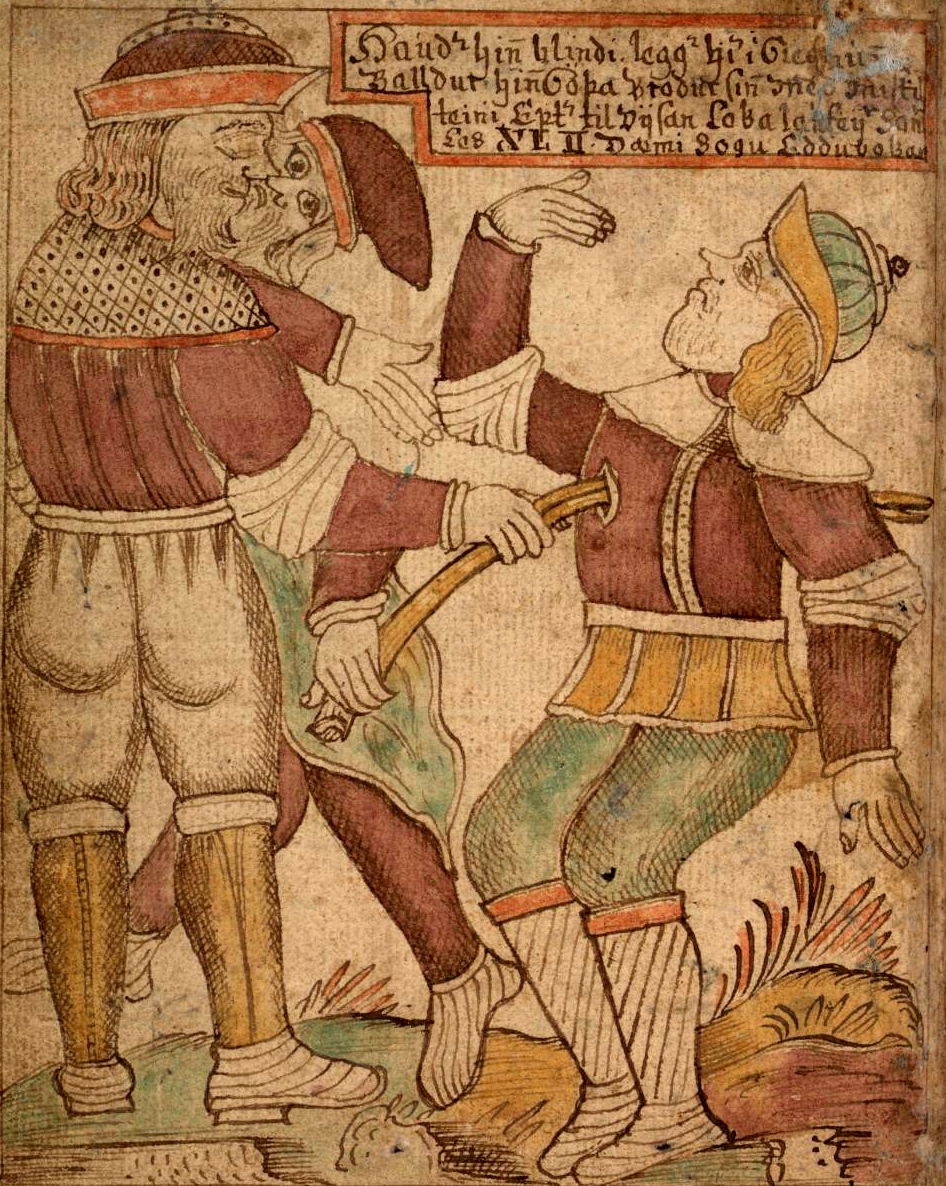
—Wait, we read that the gods threw weapons at you for fun?!
Ha! Yes, it's true, and it was a fine game. Since everything had sworn to spare me, nothing could hurt me anymore. So the gods amused themselves: they threw spears, swords, stones at me… and everything bounced off me! Imagine you are made of light, and stones pass through you without touching you. We laughed a lot in Asgard. It had become their favorite pastime. I stood in the middle, calm, while the blows rained down without wounding me. We were carefree, you see. We did not know that a single small plant was missing from the pact.
—So how did you die, if nothing could touch you?
Through trickery, my child. There was Loki, a cunning and wicked god. He disguised himself as an old woman to deceive my mother, and he discovered the secret of the mistletoe. So he carved a small arrow from that plant. Then he went to Höðr, my brother, a blind god who stood apart from the game. Loki placed the arrow in his hand and guided his arm. Imagine: Höðr thought he was just having fun like the others. The arrow flew… and I fell. All Asgard wept. The light had just gone out.
The tenderest of plants became the cruelest of arrows.
—That's so sad! Didn't anyone try to bring you back?
Yes! And that touched me deeply. A brave god, Hermóðr, mounted Sleipnir, my father's horse that has eight legs. Eight, yes! The only horse capable of galloping between worlds. He rode for nine days and nine nights, through dark valleys, to the realm of the dead. He even crossed a golden bridge, the Gjallarbrú, guarded by a giantess. There ruled Hel, the goddess of the dead. Hermóðr begged her to release me. Imagine that long journey in the cold, just for a friend. Hel finally agreed… but she set a condition.
—What was the condition? Could you come back?
The condition was gentle, but terrible. Hel said: if everything in the world weeps for Baldr, then he will return. So everything began to weep! Men, animals, trees, and even cold stones shed tears for me. But one giantess, sitting in a cave, refused. Her name was Þökk. She said she owed me nothing. And do you know who it was, under that disguise? Loki again. Because of a single creature that did not weep, I remained among the dead. I did, however, send back my father's ring, Draupnir, as a keepsake.
Everyone wept for me — except one heart of stone.
—But then, are you a gentle god or a warrior? We read both!
Ah, you have a sharp eye! Two Baldrs are told, it's true. The first, the one I tell you, comes from Snorri Sturluson, a scholar from Iceland who wrote around 1220. In his account, I am the gentle god, full of goodness. But another man, Saxo Grammaticus, wrote around 1200 in a country called Denmark. In his account, I am Balderus, a warrior prince who fights for the love of a woman, Nanna! Imagine two people telling the same dream, but each in their own way. Stories travel, you know. And as they travel, they change a little in appearance.
—And one day, will you come back for good? How does it end?
Yes, my child, and that is my most beautiful promise. The old poem Völuspá says it: there will be a great end of the world, the Ragnarök. That word means "the fate of the gods." On that day, gods and giants will fight, and many will die. But after night always comes dawn. A new world, green and clean, will be reborn from the ashes. And I will return from the dead to reign there in peace. Imagine a burned field where flowers grow again. That is why I smile despite my sad story: my death is not the end. It is a promise.
My death is not the end: it is a promise of renewal.
Read further
This imaginary interview was generated by artificial intelligence from sources documented in Baldr's profile. It dramatises what the figure might have said based on what we know about them, but does not constitute attested historical testimony. For primary sources and factual documentation, refer to the full profile.