Imaginary interview with Grace Kelly
by Charactorium · Grace Kelly (1929 — 1982) · Performing Arts · Politics · Culture · 6 min read

Monaco, an afternoon in the late 1970s. The princess receives us in a salon of the Prince's Palace overlooking the port, a string of pearls at her neck and gloves placed beside her on the armrest. She speaks softly, with that precision of articulation left over from the stage, and that caution of one who has learned that a word too many, in Monaco, travels fast.
—How do you explain that Hollywood was surprised by your 1955 Oscar?
Because I had been pigeonholed: the flawless blonde, white-gloved, pretty from a distance. Yet The Country Girl demanded exactly the opposite. I played a faded woman, badly coiffed, exhausted by an alcoholic husband played by Bing Crosby — not a hint of glamour. I read and reread that script, covered it with annotations, because I wanted them to believe in that weariness down to my hands. When my name was announced, on that March 30, 1955, ahead of Judy Garland whom everyone expected, I could only speak the truth: I had no words, except thanks to those who had believed in me. That evening, the statuette weighed less than the proof it brought: my face was not a ceiling.
I had been pigeonholed: the flawless blonde, pretty from a distance.
—Why did you insist on choosing such an unflattering role?
Because the star system creates an image for you and then imprisons you in it. MGM, the exclusive contracts, Technicolor that saturated my face with light: all of that drew a single Grace, smiling and decorative. A drab, against-type role was my way of picking the lock. I told myself that an actress who can only play her own beauty is not an actress, she's a bottle of perfume. So I demanded the wife in The Country Girl, the one no one looks at on the street. I kept the script for a long time, annotated line by line: it's the only object from that era that truly resembles me, because it shows the work, not the pose.
—What did working with Alfred Hitchcock mean to you?
A conversation between two people who knew exactly what they were leaving unsaid. Hitchcock directed me three times, in Dial M for Murder, Rear Window, and then To Catch a Thief on the Côte d'Azur with Cary Grant. He liked those blondes smooth on the surface and burning underneath; he said a woman who is too obvious has no mystery. He didn't ask me to show much, on the contrary — the Hays Code forbade everything — but to hint. In Rear Window, I had to enter the frame and kiss James Stewart in slow motion: all the desire lay in the slowness, not the gesture. At that time, young French critics were beginning to speak of the director as an auteur, sole master of his film. With Hitch, I believed it before I read the word.
He said a woman who is too obvious has no mystery.
—Do you remember the offer he made you for Marnie, in 1962?
Like a door half-opened, then closed by others than me. Hitchcock offered me the lead role in Marnie, and I said yes with an eagerness that surprised even myself. I had been princess for six years, and the idea of returning to a set made my heart race like a beginner's. But Monaco murmured, then rumbled: a Serene Highness does not play-act before a camera, it is not done. I wrote to Hitch that my life now belonged to the Rock and my children, that I had to renounce. That no cost me more than all the roles I accepted. People think a crown adds; it also subtracts.
People think a crown adds; it also subtracts.
—How did you meet Prince Rainier?
Through a coincidence no screenwriter would have dared to write. It was in 1955, during the Cannes Film Festival, while I was still filming To Catch a Thief on that Côte d'Azur that would become my home. Paris Match had arranged a visit to the Palace, a photo session, nothing more — the kind of social obligation one complains about the day before. And I walked through a gate, crossed gardens, and met a grave, courteous man who reigned over a magnificent rock set on the sea. Nothing burst forth that day; great turning points are silent. But something had been decided without me. Our wedding, the following year, was watched by millions of viewers across Europe. A press visit had changed two destinies and that of a principality.
Nothing burst forth that day; great turning points are silent.
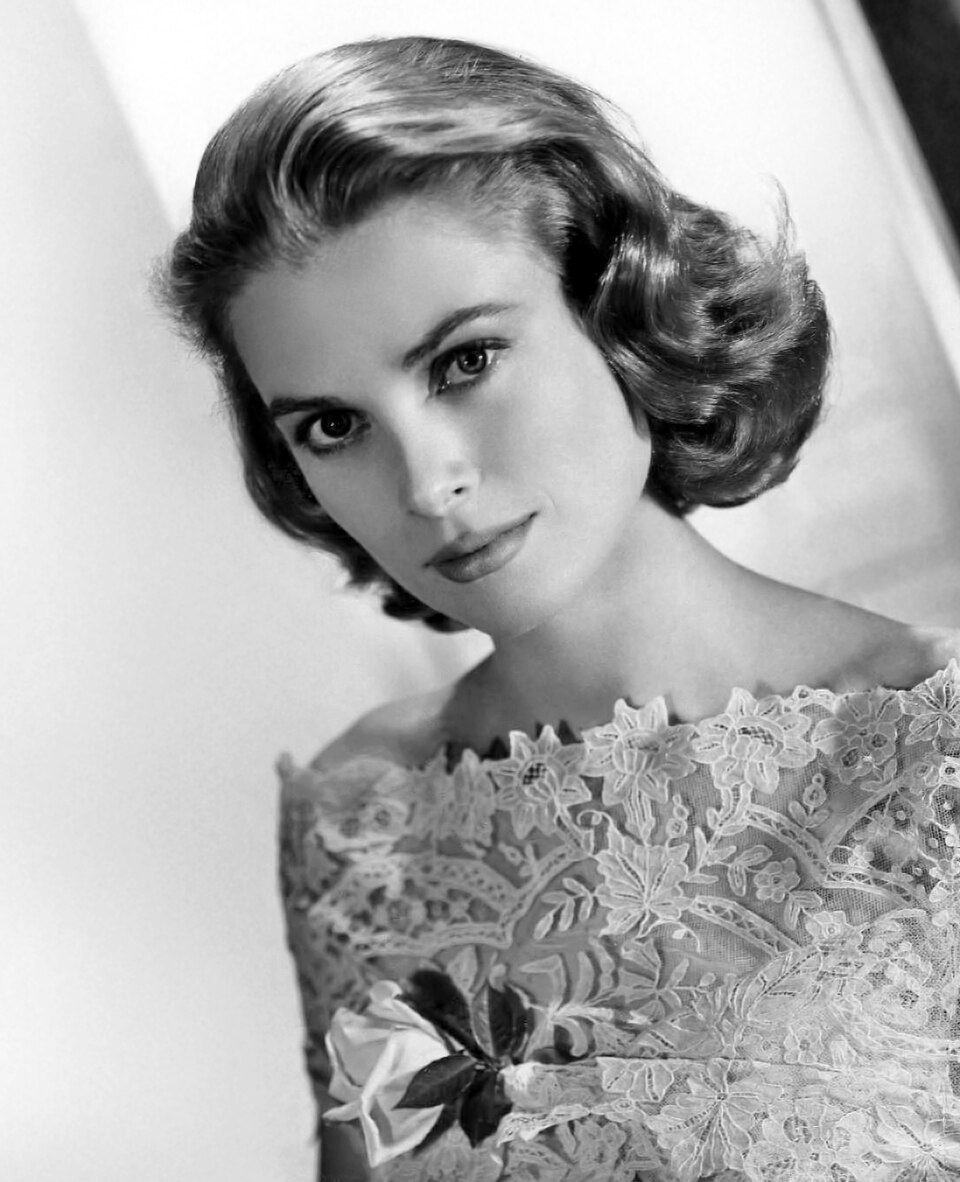
—Why leave cinema at its peak, when everything was going your way?
Because the peak, up close, looked like a beautiful room without windows. I made my last film, High Society, that musical with Bing Crosby, Frank Sinatra, and Louis Armstrong; it came out a few weeks after my wedding, like a farewell that the calendar had already signed for me. To a journalist from Life that winter, I said the only true thing: I had never dreamed of being a huge star, I loved my craft but I needed something else, a life that had meaning beyond the sets. Monaco offered me that. People pitied me for leaving Hollywood; they should have congratulated me for choosing. A career you haven't decided to stop always ends up stopping you itself.
The peak, up close, looked like a beautiful room without windows.
—How did you feel arriving in a country whose language you did not speak?
A polite, smiling, and perfectly mute solitude. At the engagement in Philadelphia, I had announced that I was ready to devote my life to this new mission — a fine phrase, except I could not yet pronounce it in French before those it concerned. So I threw myself into it like a role, but a role without breaks or understudies: hours of lessons, lists of words, the stubbornness of wanting to address my subjects without an intermediary. I clung to it as a personal pride, because you do not govern hearts by translation. The day I joked in French without thinking, I knew that Monaco was no longer a foreign principality: it had become home.
You do not govern hearts by translation.
—How do you live with the constant exposure that comes with your rank?
By learning that discretion, here, is a full-time job. In 1956, expecting my first child, I held an Hermès bag in front of me to shield myself from the lenses that watched my silhouette; the house later gave my name to that model. It's a strange kind of fame: being immortalized by the very gesture of hiding. The white gloves, the string of pearls, the structured gowns of Parisian haute couture — Dior, Givenchy, Balenciaga — all of that makes up an armor as much as elegance. I am never truly seen; what is seen is an image I adjust every morning. My only moments without surveillance, I steal at Roc Agel, in the hinterland, where the family leads a simpler, almost peasant life.
Being immortalized by the very gesture of hiding.
—Why did you make culture the great project of your life as princess?
Because a small country has no army to command respect; it has its artists. In 1963, I founded the Printemps des Arts de Monaco and took its direction, with the stubborn idea that the Rock could become a showcase of the performing arts in Europe. On the inauguration day, I said what I still believe: the arts are the living heart of a nation, they say what words cannot say and connect men across borders. Today it would be called cultural diplomacy; I saw it above all as the natural continuation of my former profession. I had served stories on screens; I now served a place where others would come to tell them.
A small country has no army to command respect; it has its artists.
—What would you say to those who think you sacrificed the artist to the sovereign?
That you can change stages without leaving the theater. I founded the Princess Grace Foundation to help young American artists at the start of their careers, those dancers, those actors no one knows yet and who tremble before going on stage — I know exactly how they feel. In the evening, in this palace, between a state dinner and an opera premiere, I sometimes watch creators that Monaco welcomes and I tell myself that I have simply moved my love of performance from the front to the wings. The actress chose her roles; the princess chooses her artists. The gesture is the same: making room for what is beautiful and fragile. I sacrificed nothing — I enlarged the stage.
You can change stages without leaving the theater.
This imaginary interview was generated by artificial intelligence from sources documented in Grace Kelly's profile. It dramatises what the figure might have said based on what we know about them, but does not constitute attested historical testimony. For primary sources and factual documentation, refer to the full profile.