Kids interview Krishna
by Charactorium · Krishna (3227 av. J.-C. — 3101 av. J.-C.) · Mythology · 5 min read
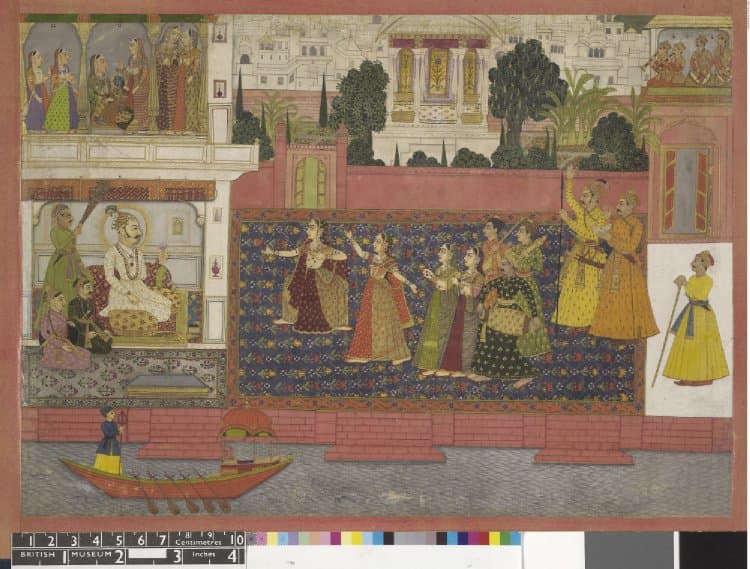
Two twelve-year-old visitors, on a school field trip, sit cross-legged on the grass. Before them, a blue-skinned cowherd, a flute tucked in his belt, smiles at them. Krishna listens, moved that children from so far away want to know his story.
—What was your childhood like? They say you almost died as a baby?
You know, my child, I was born in a prison, in Mathura. My uncle, King Kamsa, wanted to kill me: a voice had told him that I would bring him down. So on the night of my birth, my father carried me in secret to the village of Gokul. Imagine a man crossing a swollen river, a newborn pressed against him, without any light, just the sound of the water. That's where I grew up, raised by Nanda and Yashoda, my foster parents. Later, a demoness named Putana came to poison me. But a divine child does not give in so easily.
I was born in a prison, yet nothing could imprison me.
—Is it true you lifted a mountain with one finger?
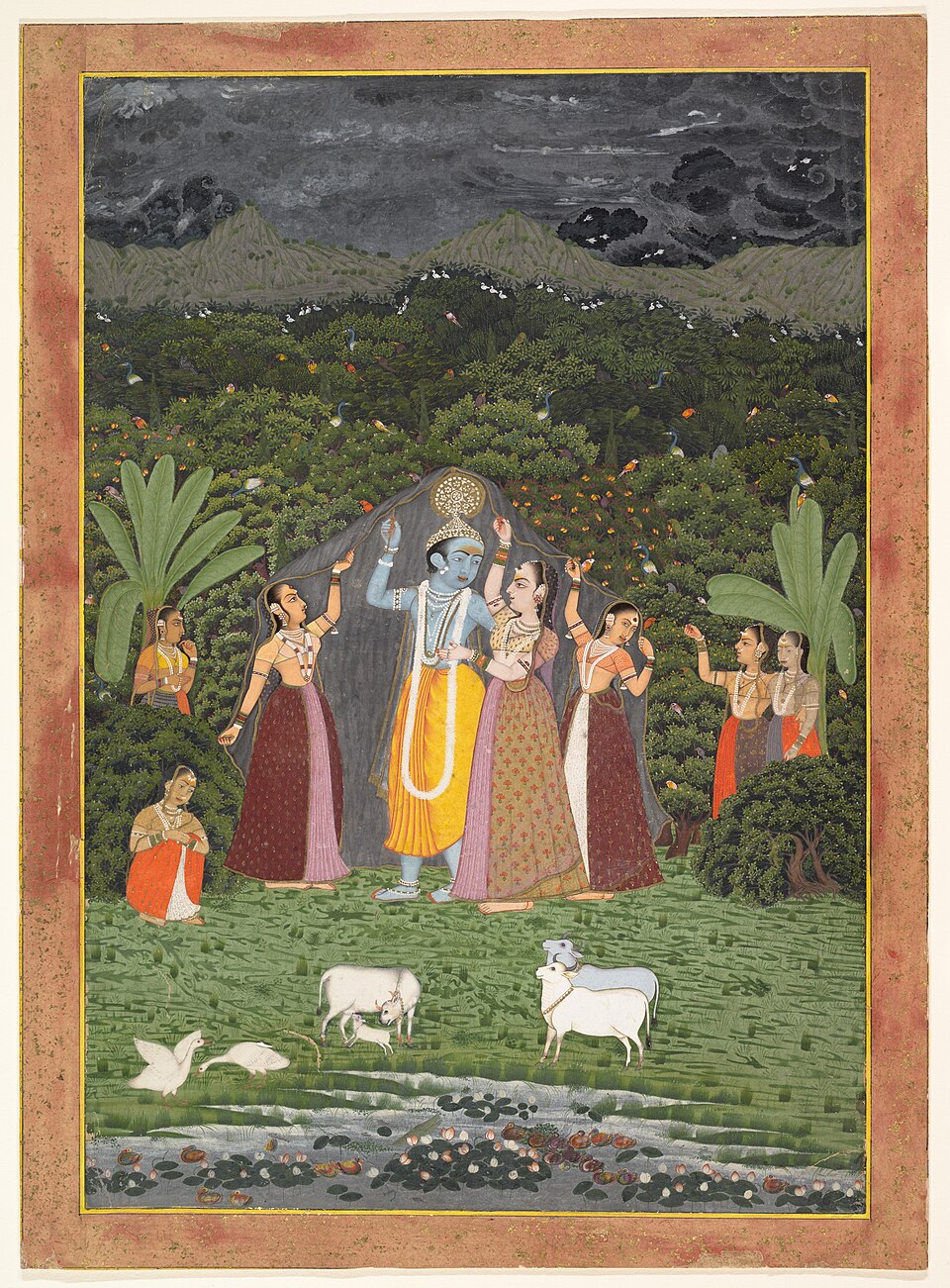
Yes! And I'll tell you why. The cowherds of Vrindavan were praying to the god Indra for rain. I told them: instead, thank the hill that feeds your cows. Indra became angry and sent a terrible storm to drown them. So I lifted Mount Govardhan like a great stone umbrella. Imagine a roof of rock, immense, and underneath a whole village huddled together, the cows, the children, safe and dry for seven days. I didn't want to take revenge on Indra. I just wanted to protect those who loved me. Protecting the weak, that is my first duty.
I lifted a mountain, but it was the smallest cowherd I was protecting.
—Why do you always have a flute with you?
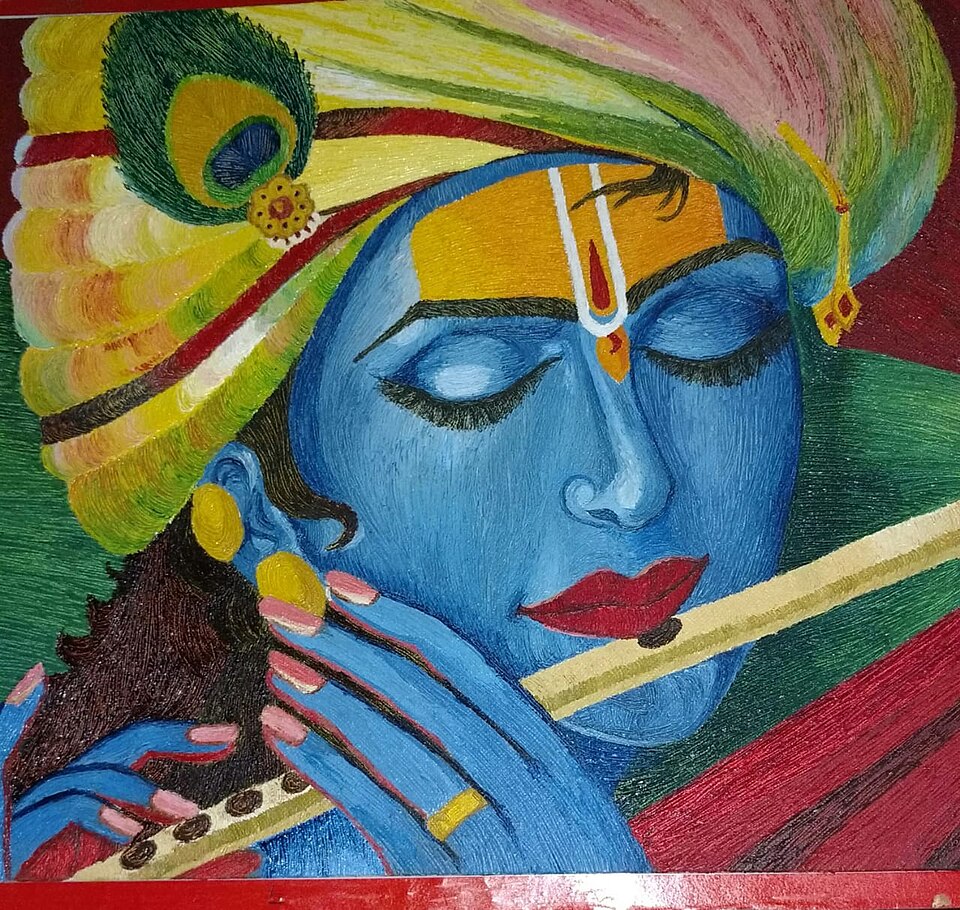
Ah, my bansuri, my bamboo flute! It is my most precious object. In the evening, in Vrindavan, I would sit under a tree and play. Imagine a sound so sweet that the cows stop grazing, the milkmaids leave their work, even the river seems to slow down to listen. It's not magic to show off. Music, you see, is a way to call hearts without saying a word. When you truly love someone, you don't need to shout: a breath is enough. My flute was my breath. And those who heard it felt that they were loved.
Music calls hearts without needing words.
—And the feather on your head, and the spinning disc, what are they for?
Good question! On my head, I wear a crown adorned with a peacock feather. The peacock is the bird that dances when the rain comes, full of joy and colors: it reminds me that the beauty of the world is a gift. But I also carry the Sudarshan Chakra, a sharp-edged disc that spins around my finger. That one is my weapon. Imagine a wheel of light, fast as lightning. The feather speaks of gentleness, the disc speaks of justice. I am both, my child: tender with those who suffer, firm against those who do wrong.
The feather for gentleness, the disc for justice: I am both.
—Did you go back to see the evil King Kamsa when you grew up?
Yes, the day came. As a young man, I returned to Mathura, the city where I was born a prisoner. Kamsa awaited me, full of fear and traps. I confronted him and defeated him. Then I did something that mattered more than anything: I went to open the prison where my real parents, Vasudeva and Devaki, had been locked up for years. Imagine their faces as they saw the light again, and their son standing before them. But other jealous kings pursued me. So later, I built my own city by the sea: Dwarka, the golden city.
I first opened my parents' prison; the throne came after.
—What was your city by the sea like?
Dwarka was my pride, in the land now called Gujarat. I founded it far from the kings who pursued me, as a refuge facing the ocean. Imagine walls that plunge into the waves, bright palaces, and the sound of boats returning to port in the evening. That's where I married Rukmini, a princess who had sent me a secret message asking me to come and fetch her before she was forced into marriage. I came. A king must rule with wisdom, but a man must also listen to his heart. In Dwarka, I tried to do both.
—Why didn't your friend Arjuna want to fight that day?
That day, at Kurukshetra, two armies of cousins faced each other. I was the charioteer of Arjuna, the warrior: I held the reins of his chariot. And at the moment of battle, he lowered his bow. Imagine: across the enemy ranks, he saw his uncles, his teachers, faces he had loved since childhood. His heart broke. "How can I raise my weapon against my own?" he said to me, his hands trembling. I understood. Arjuna's doubt was not cowardice: it was love. But sometimes, my child, love alone is not enough to know what your duty is.
—And what did you tell him to reassure him?
I turned to him, there, in the middle of the battlefield. I spoke to him for a long time: those words were preserved in a text called the Bhagavad-Gîtâ, the "Song of the Blessed One." I told him this: "You have the right to perform your duty, but not to expect its fruits. Let action be your sole concern, never its results." Do you see what that means? Do what is right, with all your heart, without spending your time calculating what it will bring you. Like when you help a friend: you do it well, without counting. The rest is not yours.
Do what is right, and do not demand the reward.
—People say you are a god. What exactly were you?
They say I am an avatar of Vishnu. The word avatar means "descent": it is when a great divinity descends to earth and takes a body, like a visitor coming to live among humans. Vishnu is the god who protects the world and keeps it in balance. And when the balance breaks, when evil becomes too strong, he descends to restore it. That balance, that just duty that holds the world upright, is called dharma. Imagine a great scale: as soon as one side leans too far toward cruelty, I come and place my hand on the other side. That is why I came.
When the world leans toward evil, I descend to set it right.
—And today, thousands of years later, why do people still talk about you?
You know, my child, it touches me that you ask. Tradition says that at my death a long difficult age began, the Kali Yuga, the age we are still in. So people have kept my words as a light for dark times. In the temples of Mathura and Dwarka, they still sing my name, play the flute, tell the story of the lifted mountain. What remains is not my throne nor my weapons: it is what I said to Arjuna. Act with courage, love without demanding. Those words, you see, never grow old. They are yours now.
My throne has vanished, my words have remained.
This imaginary interview was generated by artificial intelligence from sources documented in Krishna's profile. It dramatises what the figure might have said based on what we know about them, but does not constitute attested historical testimony. For primary sources and factual documentation, refer to the full profile.