 flip
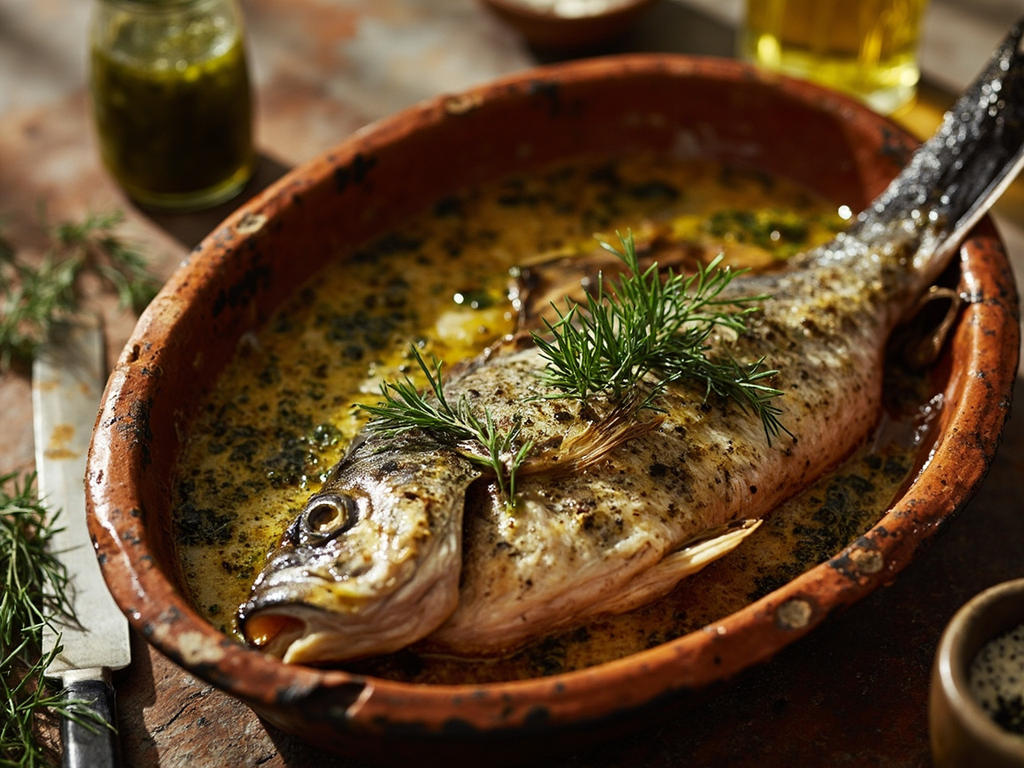
flipNile Fish Roasted with Garum, Coriander, and Cumin
Nile Fish Roasted with Garum, Coriander, and Cumin
Why this dish? Alexandria, a port open to the Mediterranean and the Nile, lived on fish: markets, salting facilities, and tables overflowed with aquatic products. During a meal hosted by a notable — a circle frequented by Hypatia, daughter of the mathematician Theon and a respected figure in the city — a fine fish roasted with garum was the dish offered to honor one's guests.
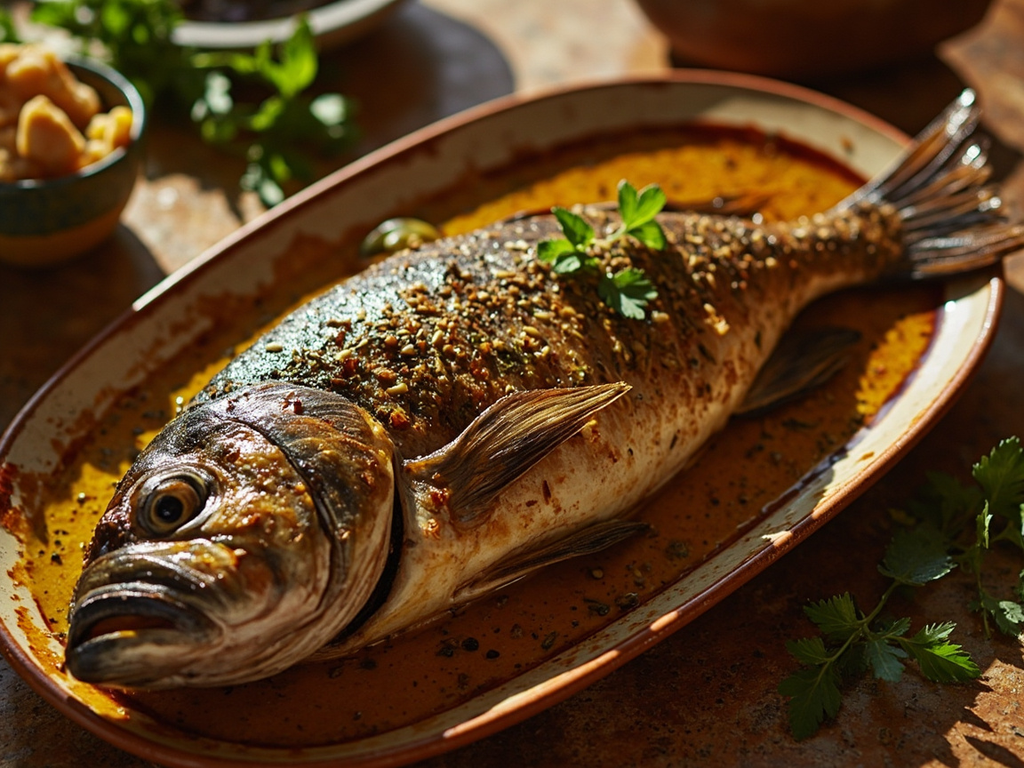
A whole roasted fish, brushed with a mixture of garum, oil, wine, and spices, scented with coriander and cumin. The quintessential reception dish of ancient Alexandria.
Here is the dish served when one wishes to honor those who share one's table. Our fishermen bring up from the Nile and the sea fish that the cook rubs with garum — that fish brine cherished by all the Mediterranean — with a little wine, oil, and fragrant seeds from the garden. It is laid whole on the embers, and we watch for the precise moment when the flesh flakes: neither too soon nor too late, for in cooking as in geometry, everything is a matter of right proportion. For my part, I take only a modest portion — but I leave my guests the joy of the feast.
- •Whole river or sea fish — a fine specimen (centerpiece)
- •Garum — as needed (umami seasoning)
- •Olive oil — generous (cooking and binder)
- •White wine — a little (marinade)
- •Coriander and cumin seeds — crushed (spices)
- •Rue or oregano — a few sprigs (herb)
- •Honey — a drizzle (roundness)
Nile Fish Roasted with Garum, Coriander, and Cumin
A whole roasted fish, brushed with a mixture of garum, oil, wine, and spices, scented with coriander and cumin. The quintessential reception dish of ancient Alexandria.
Why this dish? Alexandria, a port open to the Mediterranean and the Nile, lived on fish: markets, salting facilities, and tables overflowed with aquatic products. During a meal hosted by a notable — a circle frequented by Hypatia, daughter of the mathematician Theon and a respected figure in the city — a fine fish roasted with garum was the dish offered to honor one's guests.
Here is the dish served when one wishes to honor those who share one's table. Our fishermen bring up from the Nile and the sea fish that the cook rubs with garum — that fish brine cherished by all the Mediterranean — with a little wine, oil, and fragrant seeds from the garden. It is laid whole on the embers, and we watch for the precise moment when the flesh flakes: neither too soon nor too late, for in cooking as in geometry, everything is a matter of right proportion. For my part, I take only a modest portion — but I leave my guests the joy of the feast.
Ingredients (period version)
- Whole river or sea fish — a fine specimen (centerpiece)
- Garum — as needed (umami seasoning)
- Olive oil — generous (cooking and binder)
- White wine — a little (marinade)
- Coriander and cumin seeds — crushed (spices)
- Rue or oregano — a few sprigs (herb)
- Honey — a drizzle (roundness)
Ingredients
- Whole sea bream, sea bass, or tilapia, gutted — 1 fish, 600-800 g (centerpiece)
- Fish sauce (garum substitute) — 2 tbsp (umami seasoning)
- Olive oil — 3 tbsp (cooking and binder)
- Dry white wine — 5 cl (marinade)
- Coriander seeds + cumin seeds — 1 tsp each, crushed (spices)
- Dried oregano — 1 tsp (herb)
- Honey — 1 tsp (roundness)
- Lemon (optional, for serving) — a few wedges (acidity at serving)
Method
- Preheat the oven to 200°C. Score the fish on both sides.
- Mix fish sauce, oil, wine, honey, crushed spices, and oregano.
- Brush the mixture inside and outside the fish; let marinate for 20 minutes.
- Place on an oiled baking sheet and roast for 20 to 25 minutes, basting once halfway through.
- Check doneness: the flesh should flake easily from the bone.
- Serve whole, drizzled with cooking juices, with a few lemon wedges on the side.
How it was made : Apicius devotes an entire book to fish and garum sauces (liquamen). Garum, made by fermenting fish and salt, was the king condiment of Roman antiquity; Egypt produced and consumed it widely. Lemon, still rare and ornamental in the ancient Mediterranean, is suggested here as a modern serving touch, not period-accurate.
The contemporary twist : Bake in a salt crust scented with coriander seeds, cracked open at the table before guests — a spectacular nod to the ancient reception meal.
Sources : Apicius, De re coquinaria, Book X (fish) · Athenaeus of Naucratis, The Deipnosophists (banquets and fish)
Hypatia of Alexandria · Charactorium